



Democrats Face Uphill Battle in Virginia Redistricting Referendum
Virginia Redistricting Referendum Poses Challenge for Democrats

Democrats Confront Steep Challenges in Virginia Redistricting Fight

Top Democratic strategists are cautioning donors and elected officials that the path to passing a voter referendum in Virginia, which would likely grant the party a 10-1 advantage in congressional seats, is significantly narrower than many anticipate. They argue that the party lacks the same favorable conditions that propelled a similar referendum to an easy victory in California last November.

Key Differences Between Virginia and California

Virginia, often described as a blue-tinted swing state, is fundamentally less Democratic than California, a solidly blue stronghold. This political landscape presents a steeper climb for Democrats seeking to replicate their West Coast success. The timing of the election adds another layer of complexity, scheduled for April 21 rather than the traditional Election Day, potentially affecting voter turnout and engagement.

Furthermore, the level of gubernatorial support varies markedly. While California Governor Gavin Newsom, a Democrat, aggressively championed Proposition 50 to bolster his credentials for the 2028 presidential primary, Virginia Governor Abigail Spanberger, also a Democrat, has adopted a more passive stance toward the redistricting efforts in her state. Spanberger, a moderate focused on bipartisanship, was not involved in the General Assembly's decision to redraw the congressional maps and has expressed concerns that a 9-2 map might be more appropriate than the proposed 10-1 split.

Organized Republican Opposition and Messaging Battle

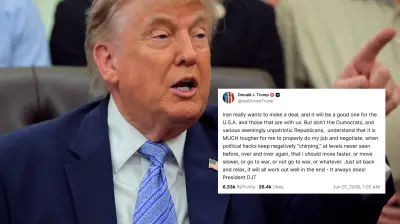
Democrats also perceive the Republican forces mobilizing against the referendum as more organized and better funded than the opposition campaign in California, which depleted its resources prematurely and descended into internal strife. The GOP effort in Virginia is closely linked to former President Donald Trump's political operation, featuring key figures with deep ties to his network.

Jared Leopold, a former Democratic Governors' Association official with extensive experience in Virginia, emphasized the messaging challenge. "This is going to be a messaging battle. People are looking for a way to push back on Trump, and this gives them a chance to do so," he said. "But this isn't California. Virginia is a blue-tinted swing state, not a true blue state. And Republicans have a more recent record of success here."

National Redistricting Context and Virginia's Pivotal Role

The Virginia referendum is part of a broader, Trump-initiated mid-decade redistricting conflict that has unfolded across several states. Republicans have actively redrawn lines in GOP-controlled states like Texas, North Carolina, Missouri, and Ohio to eliminate Democratic seats, though efforts have stalled in Indiana and Kansas. Democrats have responded with their own measures, including the successful California referendum, which is expected to help the party gain five seats, and potential actions in Maryland, New York, and Colorado after the 2026 midterms.

This makes Virginia a potentially decisive battleground in these redistricting wars. If the referendum passes, Democrats could achieve parity or even a slight advantage in congressional representation. If it fails, Republicans are likely to maintain a small edge.

Campaign Dynamics and Key Players

The significance of the Virginia fight is highlighted by the prominent figures leading the campaigns on both sides. The Democratic effort, known as Virginians for Fair Elections, is supported by officials aligned with House Minority Leader Hakeem Jeffries, who has pledged tens of millions of dollars to the cause. A nonprofit controlled by Jeffries' allies recently donated $5 million to the campaign.

On the Republican side, the group Virginians for Fair Maps, which advocates for a "no" vote, boasts extensive connections to Trump and FP1, a GOP consulting firm formerly led by top Trump aide Chris LaCivita. The campaign is spearheaded by Michael Young, Trump's former state director for Virginia and North Carolina, with Finn Lee, a former Republican National Committee "election integrity" director, serving as campaign manager. Former Virginia Attorney General Jason Miyares and former House Majority Leader Eric Cantor are assisting with fundraising efforts.

Miyares and Cantor issued a joint statement condemning the referendum as "a brazen political power grab that allows politicians in Richmond to choose their own voters. It's wrong, it's illegal, and it will fail."

Polling and Legal Considerations

Public polling on the referendum has been sparse, but a Christopher Newport University survey released last month indicated that 51% of registered voters in Virginia support the measure, with 43% opposed. Republicans hold out hope that the Virginia Supreme Court might rule the maneuver unconstitutional, though a recent decision allowing the referendum to proceed suggests legal intervention may be unlikely.

Despite the challenges, Democrats remain cautiously optimistic that voters will approve the 10-1 maps on April 21, though they acknowledge that matching the 64% margin achieved in California is improbable. Ensuring victory may require substantial financial investment and a robust messaging strategy to counter well-organized Republican opposition in a state where political dynamics are far more fluid than on the West Coast.