White House Press Secretary's Assertion on Trump's Social Media Posts Ignites Debate Over Racist Video
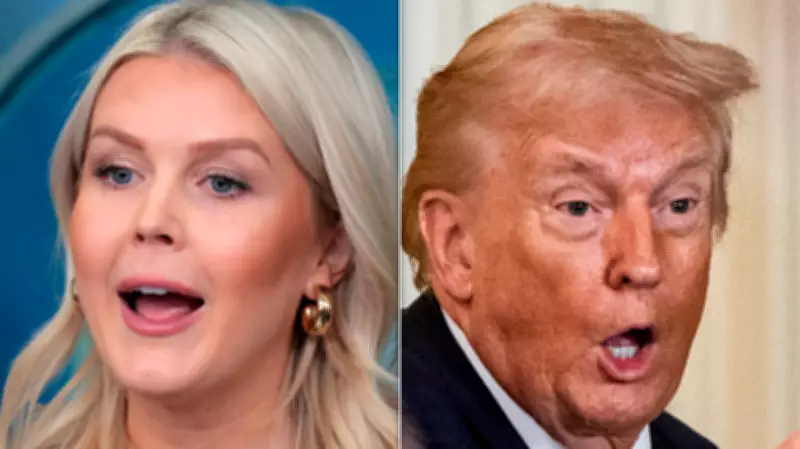
White House press secretary Karoline Leavitt's recent declaration regarding President Donald Trump's social media activity has ignited a fresh wave of scrutiny and controversy, particularly concerning a racist video that appeared on his account earlier this month. During a press briefing on Wednesday, Leavitt was questioned about a post on Trump's Truth Social platform that criticized Britain's decision to transfer the Chagos Islands to Mauritius while maintaining a 99-year lease for a joint U.K.–U.S. military base on Diego Garcia.
"The post should be taken as the policy of the Trump administration," Leavitt stated emphatically. "It's coming straight from the horse's mouth. When you see it on Truth Social, you know it's directly from President Trump." She praised this approach as the "beauty" of Trump's presidency and a hallmark of his "transparency."
Contradiction Emerges Over Racist Video Incident
However, a significant contradiction has surfaced in light of Leavitt's remarks. Earlier this month, a racist video depicting former President Barack Obama and former first lady Michelle Obama as a chimpanzee and a gorilla was featured on Trump's Truth Social account. The video was widely condemned by both Democrats and Republicans, leading Trump to delete it. Despite this, he never issued an apology, instead shifting blame away from himself.

On February 6, while aboard Air Force One, Trump told reporters, "I didn't do it, by the way. This was done by somebody else." He claimed to have only viewed part of the video, which he said focused on "fraudulent elections," and asserted that he passed it on without seeing the racist segment. "I guess probably nobody reviewed the end of it," he added. "Somebody slipped and missed a very small part."
Critics Highlight Inconsistencies and Fire Back on Social Media
Trump's critics were quick to point out the glaring inconsistency between Leavitt's statement and Trump's previous claims. On social media platform X, numerous users and public figures expressed their outrage and skepticism.
- Mehdi Hasan tweeted: "You know it's directly from President Trump. So the Obamas as apes? Directly from President Trump. She said it."
- Senator Chuck Schumer posted: "And now @PressSec confirms: Donald Trump posted the racist video of the Obamas."
- Steven J. Vaughan-Nichols commented: "They really can't keep their story straight from day to day."
- Joe Walsh added: "They all lie so much they can’t keep track of their lies."
Other users, such as AnatolijUkraine, criticized the lack of accountability, stating: "When it helps him, every post is 'official presidential policy.' When it backfires, suddenly it's 'some staffer.' Accountability that disappears on demand isn't leadership. It's a magic trick with nuclear codes." Carl Quintanilla noted: "Unless it’s a racist video — in which case it’s a nameless staffer."
Denison Barb summarized the sentiment: "So much for blaming a staffer for the racist Obama video? Leavitt just admitted that was a lie as Trump handles all his own posts." HarlemWorld questioned: "Epstein Administration at it again. i thought trump did not post the racist video ?" Steve echoed: "So the racist meme of the Obamas did come from Trump @PressSec."
Jamie Vernon highlighted the contradiction directly: "LEAVITT: When you see it on Truth Social, you know it's directly from President Trump. Really? Including the recent video?" Joe Munding concluded: "Then, by her own words, Trump himself posted the racist pic of Barack and Michelle Obama."
Broader Implications for Transparency and Accountability
This incident raises profound questions about the consistency and credibility of the Trump administration's communications. Leavitt's insistence that Truth Social posts represent official policy directly conflicts with Trump's attempt to distance himself from the racist video, creating a narrative of selective accountability. Critics argue that this undermines public trust and highlights a pattern where convenient claims are made to deflect responsibility.

The controversy underscores the challenges of navigating social media in a political context, where posts can have significant diplomatic and social repercussions. As debates continue, the focus remains on whether the administration will clarify its stance or maintain these contradictory positions, potentially affecting its perceived integrity and leadership.