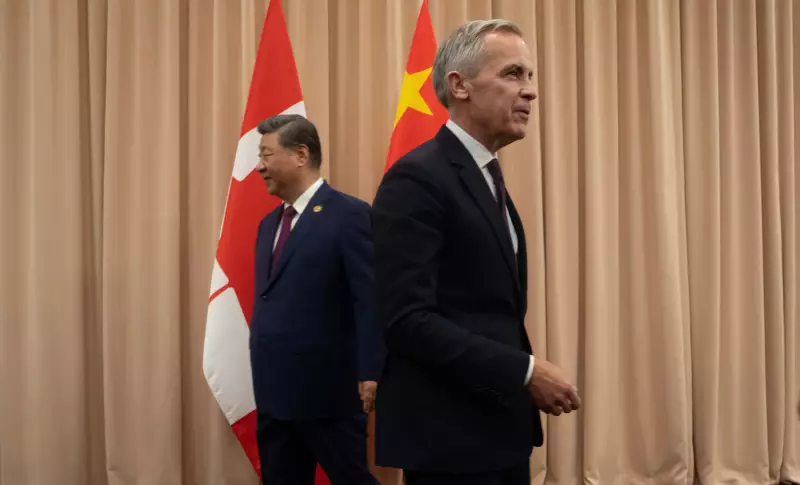
In a significant foreign policy move, Prime Minister Mark Carney is preparing for an official visit to China. The trip, scheduled for the near future, underscores a clear strategic objective for the Canadian government: to actively rebuild and strengthen bilateral relations with Beijing while concurrently working to reduce the nation's deep economic and trade dependence on the United States.
A Strategic Pivot Amidst Global Realignments
The planned visit follows a recent meeting between Carney and Chinese President Xi Jinping in Gyeongju on Friday, October 31, 2025. That encounter, captured in a photo where the two leaders are seen shaking hands and proceeding to their seats, is now viewed as a precursor to this more substantial diplomatic engagement. The decision to pursue closer ties with China reflects a calculated shift in Ottawa's international approach, driven by a desire for greater economic resilience and geopolitical flexibility.
For decades, Canada's trade and supply chains have been overwhelmingly oriented southward, with the United States acting as its dominant partner. This visit signals an intent to diversify Canada's international partnerships and explore new avenues for trade, investment, and cooperation, particularly in sectors like critical minerals and green technology.

Navigating Complex Diplomatic Waters
Rebuilding the relationship with Beijing will require careful navigation. Sino-Canadian ties have experienced considerable strain in recent years due to a series of diplomatic and trade disputes. Prime Minister Carney's mission will be to find a pragmatic path forward that advances Canadian interests without compromising on core values.
The visit is not occurring in a vacuum. It aligns with other federal efforts to engage with a broader set of global partners. Notably, Canada's Finance Minister is concurrently in the United States for discussions with G7 counterparts on trade and critical minerals, highlighting a multi-pronged strategy. Furthermore, the government has recently condemned Russia's use of hypersonic missiles in Ukraine, situating Canada's China outreach within a complex global security landscape.
Implications for Canada's Economic Future
The potential outcomes of this diplomatic initiative are substantial. Success could open doors for Canadian exporters in the vast Chinese market, secure partnerships in innovation, and provide a counterbalance to U.S. economic influence. However, the strategy also carries inherent risks and will be scrutinized by allies and domestic observers alike.
This re-engagement represents a long-term play for the Canadian economy. By cultivating a more diversified network of trade relationships, the government aims to fortify Canada against external shocks and position the country advantageously in an increasingly multipolar world. The success of Carney's talks in China will be a key indicator of how effectively Canada can execute this strategic pivot on the world stage.