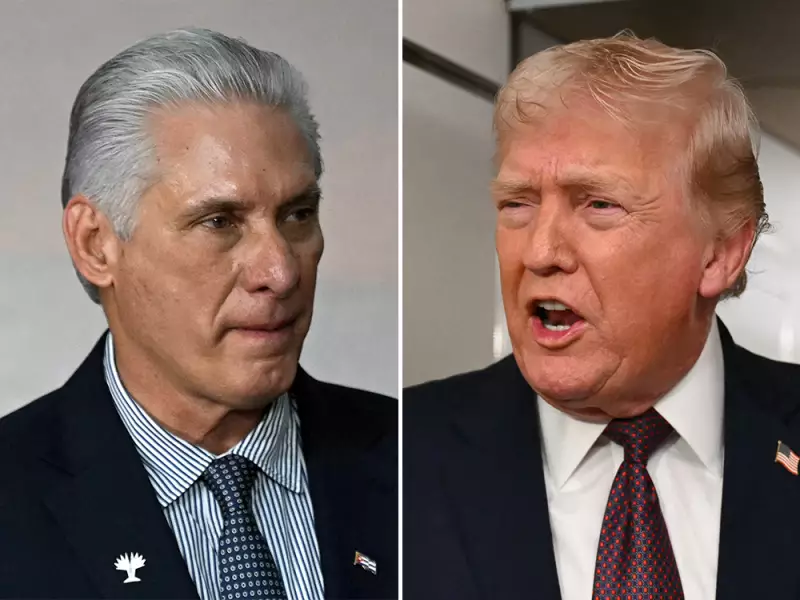
Cuban President Miguel Diaz-Canel issued a defiant response on Monday to mounting pressure from the United States, firmly denying any ongoing diplomatic negotiations with Washington and vowing to defend his nation at all costs. This comes in the wake of former U.S. President Donald Trump's threats to sever Cuba's economic lifelines following the capture of its key ally, Venezuelan leader Nicolas Maduro.
A Firm Denial and a Stark Warning
President Miguel Diaz-Canel explicitly rejected claims of dialogue with the American administration. On Monday, January 12, 2026, he stated there are "no conversations with the U.S. government except for technical contacts in the area of migration." This statement directly countered assertions made by Trump just days earlier.
The confrontation escalated when Trump, speaking aboard Air Force One on Sunday, January 11, claimed, "We're talking with Cuba." He urged Havana to "make a deal" to avoid unspecified U.S. actions, following his vow to cut off all oil and financial support Venezuela had been providing to Cuba. "THERE WILL BE NO MORE OIL OR MONEY GOING TO CUBA — ZERO!" Trump declared on his Truth Social platform, suggesting Cuba would find it hard to survive without the heavily subsidized Venezuelan crude.

Economic Strain and Historical Tensions
Cuba is currently enduring its worst economic crisis in decades, a situation exacerbated by the loss of support from Caracas. The island has faced crippling fuel shortages leading to widespread blackouts. Despite this vulnerability, the Cuban government's response has been one of steadfast resistance.
On Sunday, Diaz-Canel rallied citizens, declaring they were "ready to defend the homeland to the last drop of blood." This rhetoric echoes the long-standing adversarial relationship between the two nations, which has been a fixture since the 1959 revolution led by Fidel Castro. Historical flashpoints like the 1962 Cuban Missile Crisis underscore the deep-seated geopolitical rift.
Trump, during his first term, reversed the diplomatic thaw initiated by President Barack Obama. Immediately after the U.S. military raid that captured Maduro on January 3, 2026, Trump stated that Cuba was "ready to fall." However, reports indicate Cuba has sought alternative energy sources, with The Financial Times noting that Mexican oil exports to Cuba surpassed those from Venezuela last year.
Key Figures and Future Implications
The U.S. stance appears heavily influenced by Secretary of State Marco Rubio, a long-time critic of Cuba's communist government. Rubio, the child of Cuban immigrants, remarked after Maduro's capture that officials in Havana "would be concerned at least a little bit." Trump even reposted a message jokingly suggesting Rubio could serve as president of Cuba.
While Trump spoke of taking care of Cuban-Americans, he provided no concrete plans. The situation remains a volatile standoff, with Cuba defiantly facing economic siege and the U.S. applying maximum pressure in the aftermath of its intervention in Venezuela. The absence of clear terms for a "deal" and the fiery rhetoric from both sides suggest further instability lies ahead for U.S.-Cuba relations and the Caribbean region.