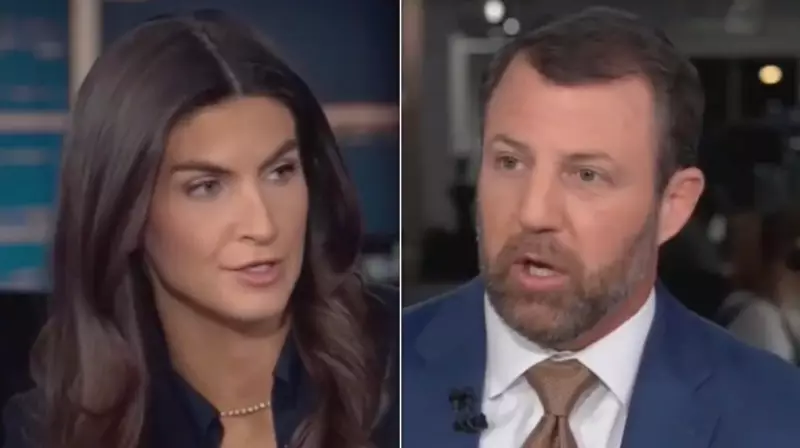
In a revealing CNN interview, host Kaitlan Collins confronted Republican Senator Markwayne Mullin of Oklahoma over his contradictory statements regarding U.S. support for regime change in Iran, leading to a series of awkward admissions.
An Interview Reveals a Policy Contradiction
During the exchange on CNN's "The Source," Collins highlighted former President Donald Trump's pledge to "come to their rescue" if the Iranian government killed peaceful protestors. Noting the ongoing demonstrations and state response in Iran, she directly asked Mullin if he supported U.S. military strikes and "taking out" the regime.
Senator Mullin confirmed his position, stating, "I would support removing the regime that's killing their own people." He attempted to draw a distinction with past U.S. interventions, arguing, "Even though we're not into regime change... this isn't the Arab Spring like it happened underneath Secretary [Hillary] Clinton." He framed potential Trump-led intervention as a rescue mission for the Iranian people.

A Clear Admission and Immediate Backtrack
Collins swiftly pointed out the inconsistency, telling the senator, "But you just said you are for regime change here." Mullin initially protested, "No, I said I'm for the strikes. I didn't say—"
Collins accurately doubled down, reminding him, "But you said, before that, you are for taking out the regime." Cornered, Mullin admitted, "Yes, absolutely. Because they're the ones murdering their own people."
He then attempted to reframe his stance, claiming, "That's different than regime change. The regime change is up to the Iranian people. We're not going actively to remove the regime. We're going after the people that are killing their own people — and that happens to be the regime."
Critics Mock Contradictions and Cite History
The contradictory comments were widely mocked by critics on social media platform X. One user succinctly noted, "If you're 'for taking out the regime,' you're for regime change." Another offered a satirical take: "I didn't say I was for regime change. I'm for taking out the old regime and putting in a new regime that favors us. How is that regime change?"
Critics of Mullin's position argued that U.S.-led regime change in the Middle East has historically not "worked out so well." They pointed to the tragic precedent of the 1953 U.S.-backed coup in Iran, which overthrew the democratically elected Prime Minister Mohammad Mosaddegh and installed Mohammad Reza Pahlavi as the Shah. This intervention led to decades of authoritarian rule and is widely seen as a root cause of subsequent anti-American sentiment and the 1979 Islamic Revolution.
When pressed on what would follow if the U.S. helped overthrow Supreme Leader Ayatollah Ali Khamenei, Mullin stated the future would be "up to the Iranian people" and that America "wasn't part of this uprising." He suggested, "You'll see a leader that will emerge. And will that be the Shah's son? Maybe. But that will be up to the Iranian people."
The interview unfolded against the backdrop of significant unrest in Iran, where the death toll from nationwide protests has surpassed 2,000 people. The geopolitical stakes are further heightened by Iran's possession of the world's third-largest proven oil reserves, trailing only Saudi Arabia and Venezuela, making its political stability a matter of global economic and strategic concern.