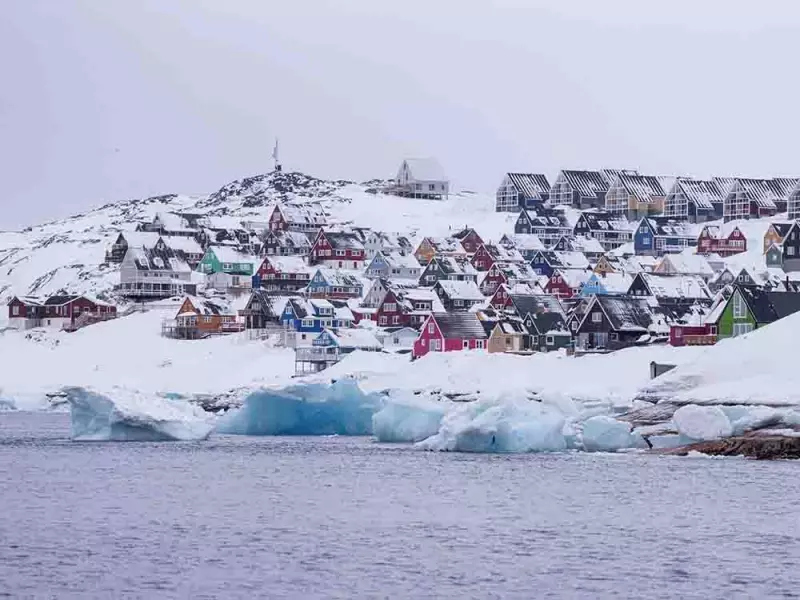
In the snow-covered capital of Nuuk, a profound anxiety has settled over the daily lives of Greenland's 57,000 residents. The distant spectre of American expansionism, championed by United States President Donald Trump, now dominates conversations more than the fierce Arctic weather. For a population fiercely proud of its Inuit heritage and hard-won autonomy from Denmark, the prospect of becoming part of what some call an 'American empire' is a chilling threat to their very identity.
A Homeland Under Threat
The notion of the U.S. seizing control of Greenland, a vast autonomous Danish territory, was long dismissed as geopolitical fantasy. That changed when President Trump, who has repeatedly floated the idea of purchasing the island, refused to rule out using military force to acquire it. Trump insists securing Greenland is an urgent national security priority, claiming Denmark has failed to defend it from Russian and Chinese incursions—an assertion local officials and fishermen vehemently deny.
For people like Maja Overgaard, who was meticulously working a sopping wet sealskin into future boots, the political storm has forced grim personal planning. She has begun discussions with her husband about fleeing to Denmark if an American takeover occurs. "I don't want to live in an American empire," she stated plainly, a sentiment echoed by her neighbours in Nuuk. Martin Rasmussen, treating sealskins nearby, has started boycotting American goods, convinced that "Trump is going to fight to the bitter end."

Local Reality Versus Geopolitical Narrative
By the quayside in Nuuk, veteran fisherman Helte Johannsen expressed bemusement at the U.S. President's claims. Having sailed the Greenlandic coastline for nearly four decades, he scoffed, "I have never seen any Russians or Chinese." As snowflakes collected in his whiskers, he added, "I don't think that Trump knows anything about Greenland." Nearby, hunter and dockworker Josef Iyberth clarified that while he spends his spare time hunting seals and reindeer, the community's guns are not for people. "Our guns are not for people," he laughed, underscoring the peaceful nature of a society now facing the prospect of invasion.
The growing sense of crisis has prompted high-level diplomatic efforts. Discussions were scheduled for the week of January 12, 2026, with U.S. Secretary of State Marco Rubio, which officials in Nuuk and Copenhagen hoped would defuse tensions. The situation has grown so severe that Rubio was forced to address the U.S. Congress, downplaying invasion rumours while confirming the U.S. prioritizes buying the island.
Broader Implications and a Firm Stance
The stakes extend far beyond Greenland's shores. Danish Prime Minister Mette Frederiksen issued an unprecedented warning, stating clearly that a U.S. attack on Greenland would mean the end of the NATO alliance. This stark declaration highlights how Trump's persistent ambition has rattled the foundational pillars of transatlantic security.
At its heart, the conflict is about more than territory and resources; it is about cultural survival. Greenlanders, whose Inuit traditions, language, and way of life have endured for centuries in one of the planet's most challenging environments, now see these as imperilled by a distant political calculation. The back-breaking work of transforming sealskins, the knowledge of the seas and mountains, and the rhythm of a life intimately tied to the Arctic landscape are all elements of a culture that feels it has no place in an American geopolitical project. As the world watches, the people of Greenland are left to hope that their homeland does not become the next pawn in a great power game.