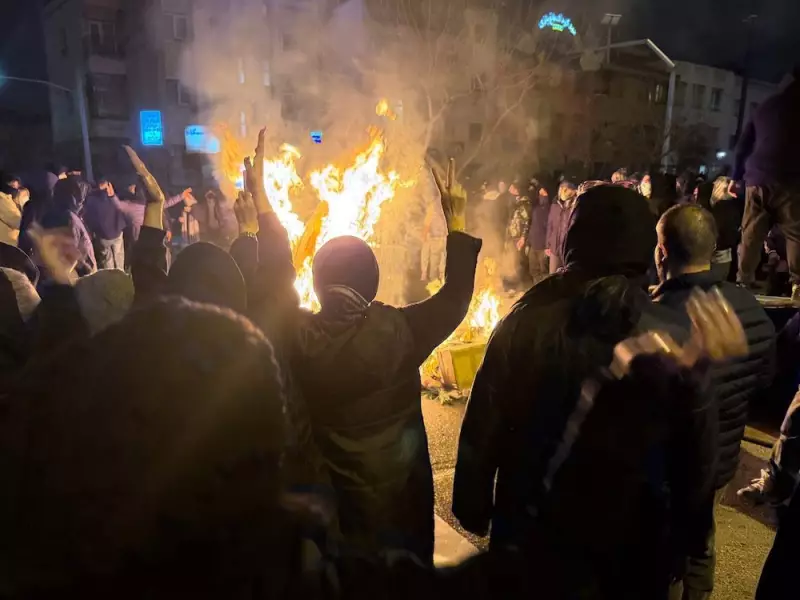
After nearly five decades of authoritarian rule, economic ruin, and sponsorship of regional militant groups, the Islamic Republic of Iran appears to be teetering on the edge of a catastrophic breakdown. The regime, in power since the 1979 revolution that ousted the Shah, now confronts a nationwide uprising of staggering scale and brutality.
A Regime Crosses the "Red Line"
In early January, U.S. President Donald Trump issued a stark warning to Tehran, vowing a withering military response if the regime used lethal force against its own citizens protesting economic collapse. Trump pledged the U.S. was "locked and loaded" and would "come to their rescue." However, similar to President Barack Obama's failure to enforce his 2012 "red line" against Syria's use of chemical weapons, the current supreme leader, Ayatollah Ali Khamenei, has crossed Trump's line with apparent impunity.
The confirmed death toll has exploded since the protests began in late December, following the collapse of Iran's currency, the rial. While the regime admits to 2,000 deaths, including security personnel it calls "martyrs," independent monitors paint a far grimmer picture. The U.S.-based Human Rights Activists News Agency has confirmed 2,403 protester deaths, including 12 children. Following a brief respite from a near-total internet blackout, CBS News reported a potential death toll of 12,000, with other estimates reaching as high as 20,000.

Revolution or Disintegration?
The prospect of a clean, democratic revolution to replace the Khomeinist police state now seems distant. Analysts warn that the more likely outcome is a horrific national disintegration. In this scenario, the hardline core of the regime, including the Islamic Revolutionary Guard Corps, could cling to power amidst the rubble of social and economic ruin, rather than being decisively overthrown.
This tragic pattern has precedent. The sustained 1979 uprising that toppled the Shah's dictatorship resulted not in freedom, but in the ascendancy of Ayatollah Ruhollah Khomeini's theocracy. Today, the international response appears similarly muddled and ineffective, raising fears of another disastrous outcome for the Iranian people.
Global Paralysis and Nuclear Distractions
Despite the escalating violence, the global left has largely ignored the crisis, while the Trump administration's response has been inconsistent. Talks between Washington and Tehran, championed by Vice-President J.D. Vance, have reportedly gone nowhere. On Tuesday, Trump reiterated support for the protesters, saying "help is on the way," but concrete action remains elusive.
Tehran has attempted to refocus discussions on reviving negotiations to curb its nuclear program—a move rich with irony. Washington's fixation on a nuclear deal under President Obama led it to abandon support for Iran's massive pro-democracy Green Movement uprising in 2009. That same preoccupation resumed during the Biden presidency, often sidelining the regime's human rights abuses. This history suggests the current protests risk being bargained away in pursuit of geopolitical deals, leaving the Iranian people to face the regime's brutality alone.
The situation remains fluid and dangerously volatile. With a communications blackout obscuring the full horror, and the international community failing to mount a coherent response, the people of Iran face a future of either prolonged, bloody repression or a chaotic state collapse, with neither offering a clear path to the freedom they seek.