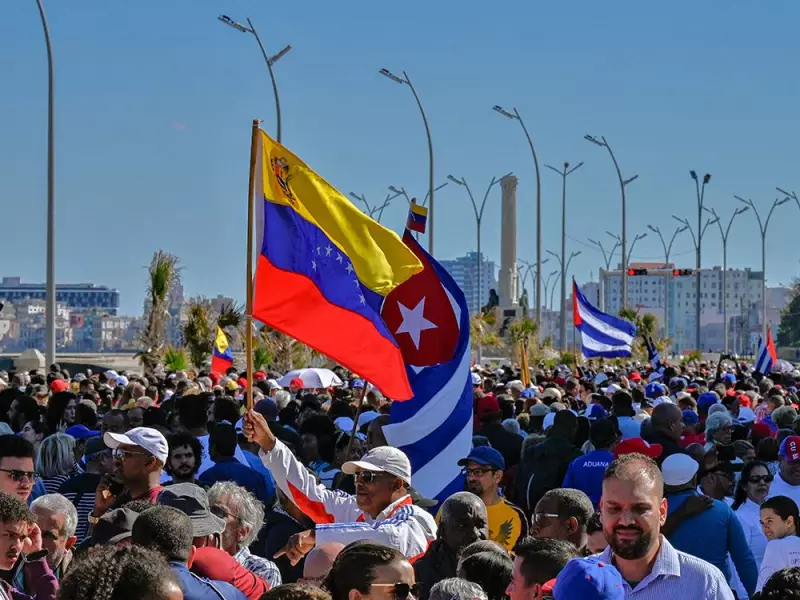
Havana is bracing for a potential confrontation with Washington, as senior U.S. Republican figures openly suggest the communist island could be the next target following a dramatic military operation in Venezuela. The heightened rhetoric comes in the wake of large-scale, government-backed protests outside the U.S. embassy in Cuba's capital.
Fallout from the Venezuela Operation
The immediate catalyst for the crisis was the American military action that led to the capture of Venezuelan President Nicolás Maduro on January 3, 2026. Maduro, like his predecessor Hugo Chávez, was a key ally and benefactor of the Cuban government, relying heavily on its intelligence services and security personnel.
The Cuban government confirmed a significant loss, stating that 32 members of its armed forces and intelligence agencies were killed during the U.S. operation. In response, Cuban President Miguel Díaz-Canel helped lead rallies in Havana where protesters, waving both Cuban and Venezuelan flags, demanded Maduro's release and denounced what they called "yankee imperialism."

Washington's Warning Shots
Prominent U.S. leaders have since turned their gaze toward Havana. Secretary of State Marco Rubio set a ominous tone at a press conference on Saturday, January 6, 2026. "If I lived in Havana, and I was in the government, I’d be concerned – at least a little bit," he warned.
His sentiment was echoed by Senator Lindsey Graham the following day. Graham accused Cuba of being a "Communist dictatorship that’s killed priests and nuns" and boldly declared that "their days are numbered." These statements have been interpreted by analysts as clear signals that the Trump administration's campaign against leftist governments in the hemisphere may be expanding.
Economic Pressure vs. Regime Resilience
President Donald Trump has presented a slightly different perspective, suggesting that a direct military intervention might not be necessary. He argued that Cuba "now has no income" following Maduro's removal, which is expected to sever the crucial, subsidized oil supply from Venezuela that has propped up the Cuban economy for decades.
However, experts on Cuban affairs urge caution against underestimating the regime's durability. Helen Yaffe, a professor of Latin American political economy at the University of Glasgow, told National Post that "it is inconceivable ... that there is enough opposition (to the current government) in Cuba" to facilitate easy regime change.
Yaffe pointed to the long history of U.S. economic warfare against the island, noting its repeated failure. "Since 1960 the U.S. has pursued a strategy to bring about the complete economic suffocation of Cuba in order to precipitate regime change," she stated. This strategy did not succeed even during the extreme hardship of the 1990s, after the collapse of the Soviet Union, before Venezuela's oil assistance began.
"The Cubans wrote the rule book on resilience," Yaffe contended, implying that the current strategy of economic isolation may prove just as futile as past efforts, and that any escalation would meet determined resistance.
The situation leaves Cuba preparing for the worst while Washington debates its next move, reviving one of the hemisphere's oldest and most contentious geopolitical standoffs.