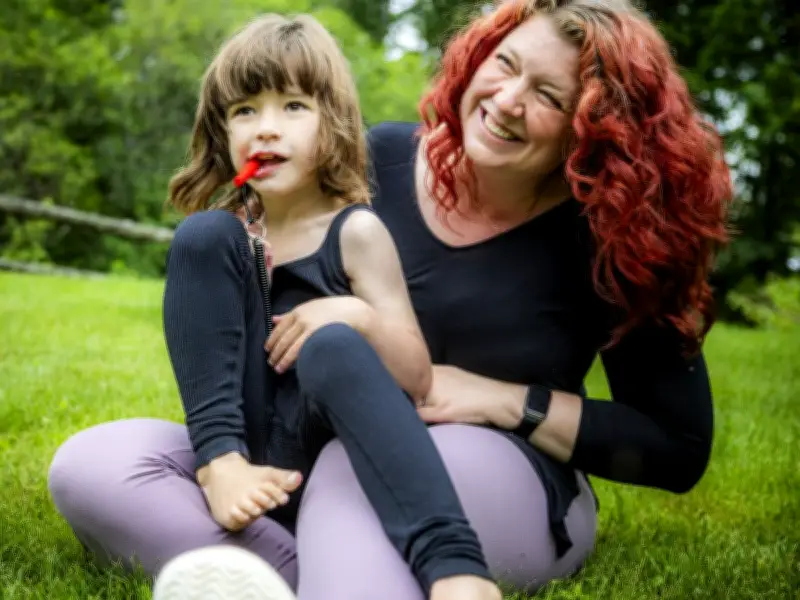
Celeste Constantineau knows the amount of time, planning and preparation that goes into attending a social event. For her six-year-old daughter, Evelyn Zanivan, who was diagnosed with Autism Spectrum Disorder (ASD) at age two, avoiding overstimulation means she needs to be in the right frame of mind before heading out. Constantineau carefully communicates the level of energy, intensity of sound, and number of people present at any gathering.
Despite the school staff at St. James Catholic School in Kanata working hard to be inclusive, Constantineau says some parents are not as understanding. “It struck me how different the school staff treats us, versus the parents,” she said. She had believed her family had found an inclusive community at the school, but that illusion was shattered when she witnessed gaps in autism awareness among some parents.
Judgmental glances and social isolation
Constantineau said some other parents cast judgmental glances toward her daughter when she played with her peers. “A lot of people push for inclusion until behaviours are overwhelming and inconvenient,” she said. The experience was overwhelming for Constantineau, who is also on the autism spectrum. She said a sense of maternal instinct had previously pushed her to avoid social settings that risked psychological harm for herself and her daughter.

“I have a hard time going to those types of events with my little one,” she said. But the safer alternative comes with its own set of consequences: a niche type of social isolation that most parents don’t understand.
Educational assistant highlights importance of socialization
Emily Jenkinson, an educational assistant at Phoenix Private Academic in Ottawa, works with more than 40 students on the spectrum. She said parents of children with special needs can sometimes be afraid to put their children in social settings because they are “afraid that their kid would get picked on,” adding that those fears are a valid concern. However, Jenkinson, who grew up with two cousins on the spectrum, emphasized the importance of socialization. “When (neurotypical) kids are exposed to kids with special needs, then they learn how to interact with them,” she said. “It’s not a big thing, it’s not a big deal. And it’s fine.”