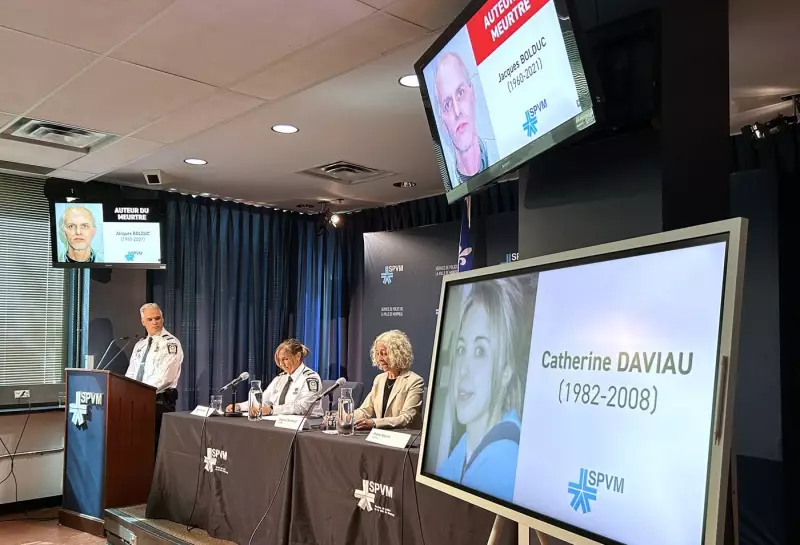
In a significant victory for forensic science and justice, police in Montreal announced the resolution of a 17-year-old murder case in late 2025, crediting major advances in DNA analysis technology. This breakthrough is part of a broader trend where once-stalled investigations, known as cold cases, are being reopened and solved with new scientific tools.
A Long-Awaited Break in a Montreal Murder
On Wednesday, September 17, 2025, senior officials from the Montreal police and the provincial crime lab held a news conference to announce a major development. The 2008 murder of Catherine Daviau had finally been solved. The announcement was made by Montreal Police Commander François Sauvé, Commander Mélanie Dupont, and Suzanne Marchand, the senior executive director of the provincial crime lab.
The case, which had grown cold over many years, was reignited by applying contemporary DNA analysis techniques to existing evidence. While specific details of the arrest were not fully disclosed at the conference, authorities emphasized that the resolution was directly due to technological progress in forensic science that was not available at the time of the original investigation.

The Power of Modern Forensic Science
The successful closure of the Daviau case underscores a national shift in how law enforcement approaches unsolved crimes. Across Canada, police departments are revisiting cold case files with a new arsenal of genetic and analytical tools. These include more sensitive DNA testing, genetic genealogy, and improved evidence processing methods that can extract profiles from minute or degraded samples.
This technological evolution means that evidence collected years or even decades ago can now yield clues that were previously impossible to find. For families of victims, these advances offer a renewed, and often unexpected, hope for answers and accountability after many years of uncertainty.
Implications for Justice and Future Investigations
The resolution announced in Montreal is not an isolated incident. Throughout 2025, similar announcements were made by various police services in Canada, pointing to a year where cold cases transitioned from frozen to closed at a notable pace. Each solved case serves as a powerful testament to the persistence of investigators and the evolving promise of forensic science.
Furthermore, these successes are prompting reviews of other unsolved homicides and major crimes. Law enforcement agencies are increasingly dedicating resources to cold case units, knowing that today's science can crack yesterday's mysteries. This trend reinforces the principle that the pursuit of justice does not fade with time, especially as scientific capabilities continue to grow.
For the family and friends of Catherine Daviau, the September 2025 announcement marked the end of a painful 17-year wait. For Canadian law enforcement and forensic experts, it represents a compelling validation of their ongoing work to harness science in the service of justice, providing closure for families and making communities safer.