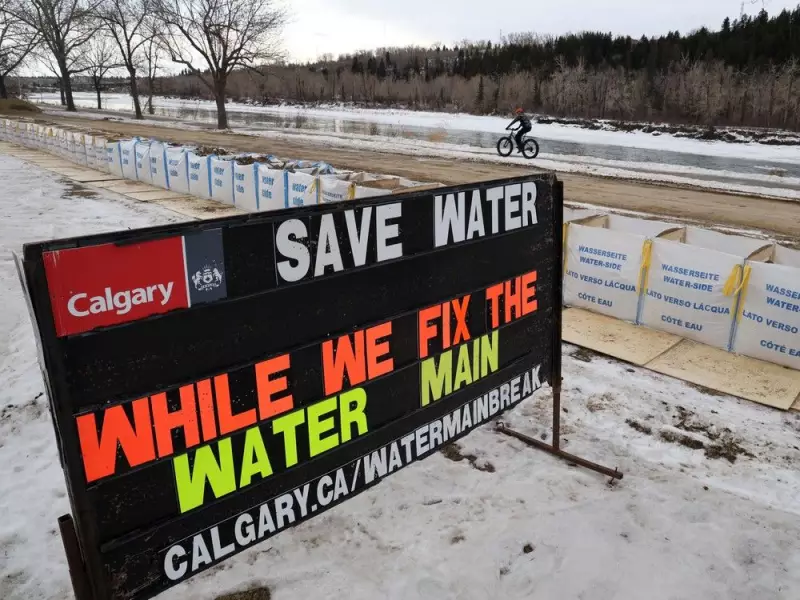
While Calgary prepares to lift water use restrictions early next week, city officials are simultaneously implementing protective measures for several northwest neighbourhoods deemed at risk from potential future ruptures of the problematic Bearspaw South feeder main.
Proactive Flood Defences Deployed
According to Michael Thompson, the city's general manager of infrastructure services, crews are taking a two-pronged approach to manage flood risk. Two sections of a Bow River berm along Montgomery Boulevard N.W. are being deliberately removed. This counterintuitive step is designed to prevent water from being trapped within the community if the pipe fails.
"This berm would actually keep water in the community so we're creating openings to allow water to flow to the river in the event of an unexpected break in the pipe," Thompson explained.

Concurrently, temporary barriers have been installed on the river pathway on Parkdale Boulevard between 30th and 33rd Street to block potential floodwaters. The city is also preparing pumps to drain any lower-lying areas and is clearing catch basins.
Responding to a "Terminally Ill" Pipe
These actions stem from heightened concerns about a 7-kilometre section of the 51-year-old water main, which catastrophically ruptured on December 30th on 16th Avenue near Sarcee Trail N.E. This was the pipe's second major failure in just 18 months.
"On Dec. 30, our understanding changed and we need to change the way we're going to act and plan going forward," said Thompson. He emphasized that while another break is not expected, the city is putting contingency plans into effect.
Mayor Jeromy Farkas echoed the seriousness of the situation, calling the feeder main—which normally supplies 60 percent of Calgary's drinking water—"terminally ill." He warned that the city is not yet out of danger, especially during the current critical phase of repressurizing the repaired pipe.
"We're not out of the woods yet. Once we're in the position to pressurize the pipe, there's still the risk of another failure," Farkas stated.
Repairs and Long-Term Plans
Current work includes repaving the damaged eastbound lanes of 16th Avenue, which should reopen next week. Meanwhile, crews are slowly filling the repaired feeder main with water—a process requiring 22 megalitres, equivalent to nine Olympic-sized swimming pools—to minimize stress on the aging infrastructure.
The city has acknowledged that the existing vulnerable main will need reinforcement work extending into the spring, and plans to replace it entirely are being accelerated.
Water consumption remains a concern. On Friday, January 9th, Calgarians used 504 million litres of water. Although this was 4 megalitres less than the previous day, it marked the sixth consecutive day of unsustainable consumption levels, placing significant strain on the smaller Glenmore Water Treatment Plant as it serves 1.7 million people.