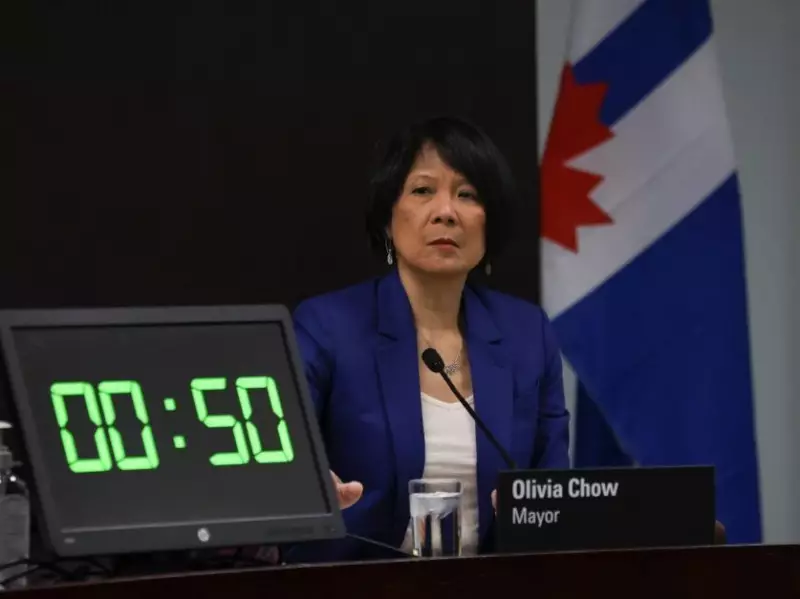
Toronto Mayor Olivia Chow has sparked political speculation after suggesting she might not seek re-election in the 2026 municipal race. During a recent podcast appearance, the 68-year-old mayor expressed uncertainty about her political future while defending her current priorities.
Chow's Uncertain Political Future
Appearing on the Can't Be Censored Podcast with hosts Travis Dhanraj and Karman Wong, Chow offered ambiguous responses when questioned about her re-election plans. "I don't know," Chow stated when directly asked about running again. "I love my work. Whether I will run again, I don't know, right now I'm so busy putting the budget together, getting housing built."
Despite these public uncertainties, political observers note that Chow's team appears to be actively preparing for a campaign. Her chief of staff Michael Hay and campaign manager Brian Topp have reportedly been organizing meetings and reaching out to supporters, suggesting preparations are underway for another mayoral bid.

Controversial Policies Under Scrutiny
Chow's administration has implemented several controversial policies that critics argue are damaging Toronto's future. The mayor's housing strategy, which aims to make the city bureaucracy the primary housing developer in Toronto, has raised concerns given Toronto Community Housing's troubled history.
Taxation has become another flashpoint under Chow's leadership. Her first budget introduced a 9.5% property tax increase, followed by a 6.9% hike the subsequent year. Over the past four municipal budgets, Toronto homeowners have faced a cumulative tax increase of 29.5%, while many residents report declining service quality.
Public Safety and Homelessness Crisis
The city's approach to homeless encampments has emerged as a particularly contentious issue. Councilor Brad Bradford recently revealed that 355 homeless encampments currently exist in Toronto parks, despite the city nearly doubling shelter bed capacity to approximately 10,000 spaces.
During a recent council meeting, Bradford proposed clearing encampments within 200 meters of playgrounds, schools, and daycare centers within 48 hours. Chow and her council allies amended the motion to reduce the distance to 50 meters, meaning only 18 encampments (5% of the total) would be affected instead of 199 encampments (56%) under the original proposal.
These encampments have become sites of open drug use, with crack pipes and needles frequently found in adjacent playground areas, creating safety concerns for children and families.
Surprise Move Against Parking Authority
In another controversial move, Chow recently pushed to dissolve the board of the Toronto Parking Authority, the city's only profitable and efficient operation. Critics suspect the mayor wants to bring the authority under direct city control to access its revenue streams and potentially use parking assets for financing city projects.
While Chow claimed the move was about finding efficiencies, she notably excluded other arm's-length agencies like the TTC from similar treatment, stating the transit system "works just fine as it is" despite widespread public concerns about safety and reliability.
As Toronto approaches the 2026 municipal election, the debate over Chow's leadership and policy direction continues to intensify, with opponents arguing the city needs a new approach to address its growing challenges.