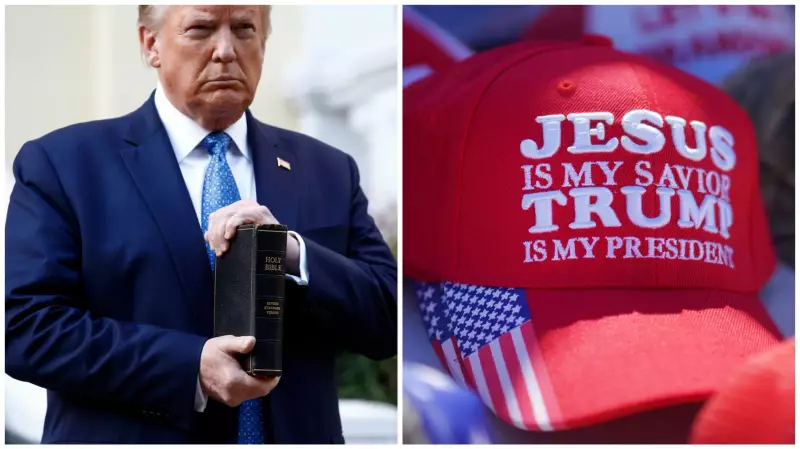
Former President Donald Trump's preoccupation with the afterlife surfaced again during an unexpected appearance at a Mar-a-Lago wedding last week, where he openly questioned whether he would reach "the good place" and sought spiritual reassurance from conservative commentators.
Wedding Crash Sparks Heavenly Conversation
While attending the nuptials of banker and Stormwall founder Mike Wilkerson, Trump spotted conservative radio host Eric Metaxas among the guests and immediately referenced his spiritual concerns. Trump pointed directly at Metaxas and told the newlyweds, "He's going to get me into heaven."
The exchange, later shared on Metaxas' Instagram, captured the radio host's diplomatic response: "I want to talk to him about getting into heaven... but not here. Not here." In subsequent comments, Metaxas explained his wedding-appropriate discretion, noting that while he would "love to have that conversation with him one day," the wedding setting wasn't appropriate for such discussions.

A Pattern of Afterlife Inquiries
This wasn't the first time Trump has publicly expressed concerns about his celestial destination. In August, during a Fox News call, he wondered if his efforts to end the war in Ukraine might improve his heavenly prospects. "I want to try and get to heaven, if possible," he stated. "I'm hearing I'm not doing well. I am really at the bottom of the totem pole."
Later that same month, while speaking with radio host Todd Starnes, Trump questioned the very motivation for moral behavior without the promise of heavenly reward. "If you're not a believer, and you believe you go nowhere, what's the reason to be good, really?" he asked, suggesting that religious people behave well because "they get punished if they're not good."
Most strikingly, in an October conversation with Steve Doocy, Trump expressed pessimism about his spiritual fate, stating, "I don't think there's anything that's going to get me into heaven. I think I'm not heaven-bound."
Theological Perspectives on Trump's Quest
Experts note that Trump's repeated use of "get me into heaven" language reveals a particular understanding of salvation. Therapist Sobeyda Valle-Ellis, director of HeartMatters NYC, describes this as "a performance-based and transactional misunderstanding of salvation and heaven."
Valle-Ellis explains that Trump appears to be thinking, "If I do this many good deeds, maybe I'll make it to heaven," which conflicts with traditional Christian teaching that salvation comes through grace rather than works. "This is actually what many people believe about heaven, even some Christians," she acknowledges.
Psychologist Rachel Menzies, author of "Mortals: How the Fear of Death Shaped Human Society," suggests that Trump's behavior reflects a common human tendency. "The idea that goodness or achievement can somehow protect us from the finality of death is believed by many," she notes, describing it as a way to manage the uncomfortable truth that mortality lies outside human control.
Biblical teachings offer contrasting perspectives to Trump's apparent worldview. Matthew 19:23-26 notes the difficulty for wealthy individuals to enter heaven, comparing it to a camel passing through the eye of a needle. Similarly, 1 Timothy 6:9-11 warns that "the love of money is a root of all kinds of evil" and that those eager for wealth often wander from faith.
As Trump continues his public exploration of spiritual matters, his questions reflect broader human concerns about mortality and meaning. Whether his late-in-life faith journey will lead to different understandings remains uncertain, but his repeated inquiries suggest these questions weigh heavily on his mind.