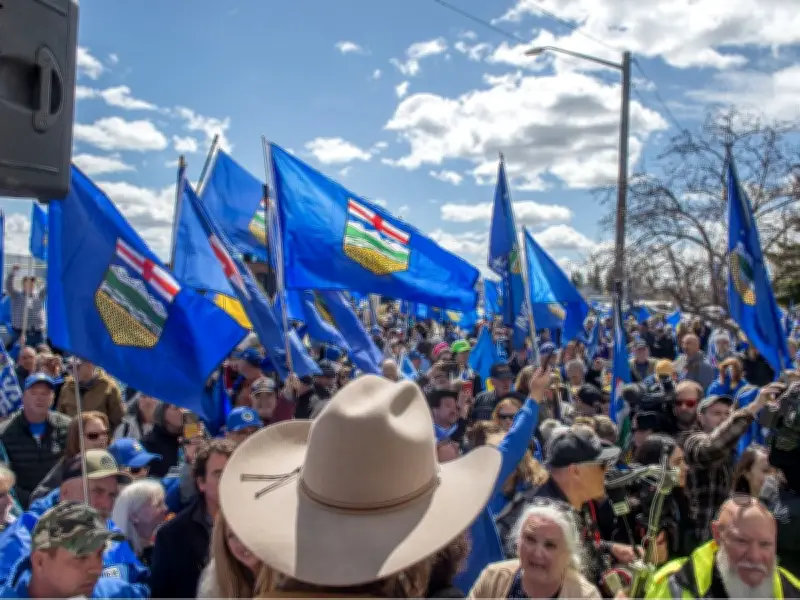
An Alberta judge heard arguments Thursday on an appeal that could once again throw a provincial separation referendum into turmoil.
Court of Appeal Justice Alice Woolley is considering whether to stay last month’s ruling from Court of King’s Bench Justice Shaina Leonard, who quashed a decision to issue a citizen initiative petition on Alberta independence.
Leonard said Alberta’s chief electoral officer did not meet his constitutional duty to consult First Nations about potential treaty breaches before allowing separatist organizers to gather signatures on the question. The Alberta government and the separatist Alberta Prosperity Project appealed, while Premier Danielle Smith opted to move forward with an Oct. 19 referendum on whether Alberta should remain in Canada, or whether a binding separation vote should take place at a later date.

Legal Intricacies Discussed
Throughout Thursday’s hearing, Woolley and lawyers for the parties discussed the legal intricacies of Leonard’s decision, as well as what would happen if the Court of Appeal throws out the lower court ruling.
At this stage, Woolley is considering only whether to stay — or legally put on hold — Leonard’s ruling until the broader question of whether the decision should be overturned can be heard by a panel of Court of Appeal judges.
Woolley said she has concerns about some aspects of Leonard’s decision — including the finding that when the chief electoral officer issues a petition under the Citizen Initiative Act, it sets in motion a process that requires the government to implement the results of the referendum.
Separatist lawyer Jeff Rath said the government is under no such obligation and that the petition process only amounts to citizens letting “their wishes be known.”
Hypothetical Scenarios
Thursday’s hearing also dealt with several hypotheticals — such as what would happen if the pro-Canada side wins this fall’s referendum and the Alberta Prosperity Project wins the appeal. Paul Reid, lawyer for the Blood Tribe, told Woolley he believes there would be nothing stopping a second referendum on Alberta separation.
Expression of the Political Will
Rath, who represents separatist leader Mitch Sylvestre, was granted the most speaking time as the primary appellant. The Government of Alberta lawyer spoke for only a few minutes to answer questions from Woolley, relying instead on written submissions.
Rath said Leonard’s decision is the first time a Canadian court has found governments have a duty to consult First Nations when it comes to hearing from the electorate — “well beyond the realm of decided law in Canada regarding the nature of the duty to consult.”
Rath accused the First Nations of failing to specify what treaty rights they would be infringed by the mere “collection of signatures.” He insisted there is nothing binding about the citizen initiative process, calling it “merely an expression of the political will of a populace which the government may or may not follow.”