Doug Ford's Strategic Shift Toward Liberal Majority Government
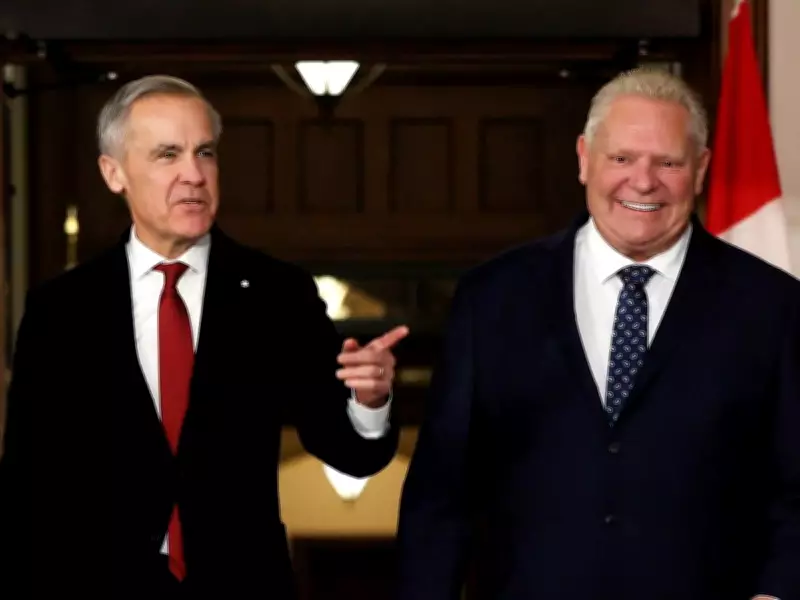
As political dynamics shift in Ottawa, Ontario Premier Doug Ford finds himself in an unexpected position: openly embracing the prospect of a Liberal majority government under Prime Minister Mark Carney. This represents a significant departure from traditional partisan alignments and reveals the complex calculations driving Ford's political strategy.
The Original Motivation: Fear of Poilievre's Conservative Government
Ford's current position becomes more understandable when examining his original motivations. The premier's decision to call an early election last year wasn't primarily about positioning himself for trade negotiations or adopting patriotic symbolism. The driving force was genuine concern about facing re-election while a Pierre Poilievre-led Conservative government held power in Ottawa.
Ford anticipated that a Poilievre administration would bring Conservative austerity measures, job cuts, and culture-war politics that could create collateral damage for a provincial Conservative leader, even one who positions himself with progressive modifiers. The premier has consistently avoided culture-war issues and recognized how federal Conservative policies might negatively impact his provincial prospects.

Political Landscape Transformed
Ford's fears proved remarkably misplaced. Canadian voters rejected Poilievre's Conservatives and instead returned to the familiar territory of Liberal governance, though with Mark Carney rather than Justin Trudeau at the helm. This electoral outcome has fundamentally reshaped Ford's political calculations and relationships.
Carney has since engineered backroom political maneuvers that position him on the brink of achieving parliamentary majority status, pending upcoming federal byelections in Toronto and Montreal. This development appears to align perfectly with Ford's current political interests and preferences.
Ford's Public Endorsement of Liberal Majority
During a recent trade mission to Texas, Ford essentially endorsed Liberal candidates in the approaching byelections by telling the Toronto Star that he "just believe(s) in majority governments" and that the certainty such governance would provide in Ottawa would be ideal as the United States reconsiders its trade relationships globally.
The premier's comfort with this political direction was further reinforced by Wednesday's announcement that former Conservative MP Marilyn Gladu had joined Carney's expanding Liberal coalition. While Gladu represents such strident conservative views that her proximity to Liberal leadership might normally concern Ford, her defection actually strengthens Carney's path to majority status.
Strategic Calculations and Personal Affinity
Ford correctly notes that a Liberal majority could marginally assist trade negotiations, though Carney has been governing with majority-like confidence for some time already. The opposition parties have shown little appetite for triggering an election, creating stable conditions that benefit Ford's provincial agenda.
Beyond pragmatic considerations, Ford's admiration for Carney appears genuinely personal. In his Star interview, the premier described the prime minister as a "very astute business person," a "sharp guy" and "a good man." The warmth of these compliments contrasts sharply with Ford's notably cooler references to Poilievre, whom he typically acknowledges merely as someone who exists, sometimes with even less enthusiasm.
Historical Tensions Between Conservative Camps
The strained relationship between federal and Ontario Conservative factions is well documented, having erupted publicly during the last federal campaign when Ford advisor Kory Teneycke used particularly colorful language to characterize Poilievre. When questioned about these remarks, Ford simply noted that "the truth hurts," revealing the depth of division within conservative circles.
As political dynamics continue evolving, Ford's alignment with Carney's Liberal government represents a fascinating case study in realpolitik, where traditional partisan boundaries yield to strategic calculations and personal chemistry between leaders.