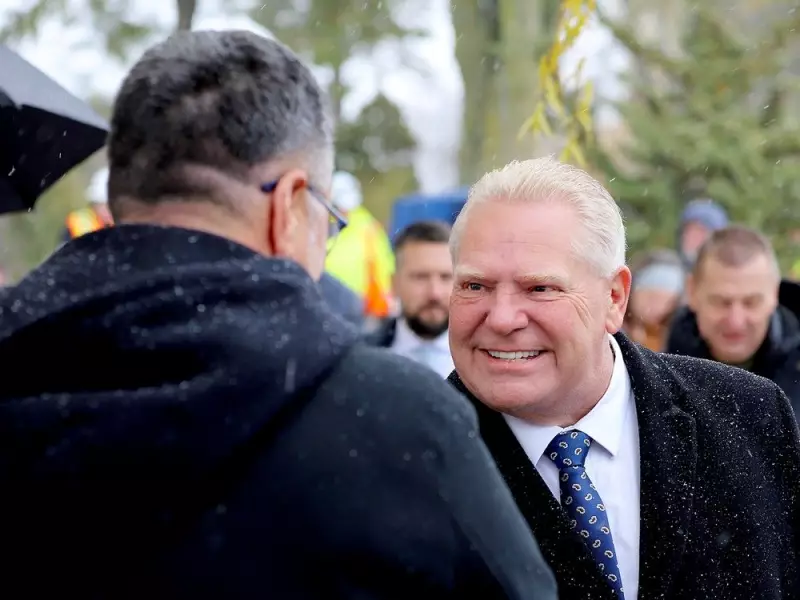
Ontario Premier Doug Ford has long positioned himself as a leader in tune with the everyday worries of the province's residents. However, his first major press conference of 2026 has sparked questions about whether that connection still holds, as his relentlessly positive economic message appeared disconnected from the financial pressures facing ordinary households.
A Premier's Positivity Versus Public Pessimism
The contrast between the premier's narrative and the public mood is stark. Recent polling data paints a picture of a concerned populace. A Leger poll indicated that 55% of Ontarians believe the province is on the wrong track, with housing costs and general affordability ranking as their top issues. Further underscoring the discontent, an Angus Reid Institute survey in December 2025 gave the Ontario government a mere 20% approval rating—the lowest in the country and a nine-point drop since the previous March.
Yet, at his Tuesday press conference, Ford did not directly address these pressing concerns. Instead, he offered a bullish vision focused on long-term economic projects. He declared Ontario was on its way to becoming "the most competitive, resilient and self-reliant economy in the entire G7" and touted its rise as a "global nuclear energy superpower." He expressed a palpable feeling that 2026 would be a "very positive" year, while briefly acknowledging there would be "bumps" along the way.

Economic Forecasts Tell a Different Story
While optimism is a valuable trait in a leader, analysts suggest the premier's cheer may be out of step with current economic projections. Key forecasts for 2026 suggest a more challenging year ahead for Ontario than Ford's comments imply.
TD Economics predicts Ontario's real GDP growth will be just 1% this year, aligning closely with the province's own forecast of 0.9%. If realized, this would be the lowest growth rate in Canada. The financial institution also forecasts a 0.2% decline in employment for Ontario, with an average unemployment rate of 7.5%—figures that are worse than the national average.
The premier highlighted $28 billion in new investments and nearly 57,000 jobs created in the past year. However, this figure must be viewed in the context of Ontario's total workforce of 6.7 million full-time positions. Furthermore, Ford's claim that Ontario is "leading the world in critical minerals" is factually inaccurate; that global leader is China.
Spending Priorities and Public Perception
Ford dedicated significant time to listing his government's infrastructure achievements: new roads, transit lines, power plants, and other large-scale projects. While these are long-term investments, they offer little immediate solace to families struggling with weekly grocery bills or soaring rent payments.
This emphasis has led to criticism that the Ford government has ample funds for its own capital priorities but is perceived as less focused on the direct, pocketbook issues causing voter anxiety. The political risk is clear: when citizens are forced to pinch their own pennies, watching the government embark on a visible spending spree can breed resentment.
The premier pointed to a strategic economic plan built on critical minerals, nuclear energy, life sciences, and defence. Notably absent from his remarks was any detailed mention of Ontario's auto sector, despite the government's multi-billion-dollar bets on securing its electric vehicle future.
The core question raised is one of alignment. Premier Ford, a salesman at heart, is betting on a future of economic strength. Meanwhile, a majority of Ontarians, according to polls, are preoccupied with present-day economic strain. Bridging that gap may require less time selling an optimistic future and more time demonstrating a concrete, empathetic plan for the pressing now.