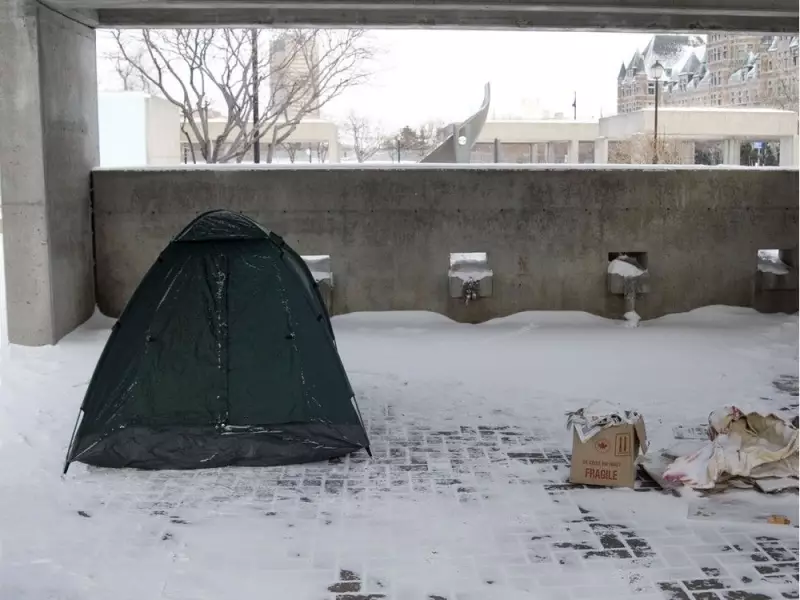
With winter conditions arriving unexpectedly early this year, Québec Solidaire is urgently demanding the provincial government create 500 additional emergency shelter spots for Montreal's unhoused population. The political party's homelessness spokesperson, Guillaume Cliche-Rivard, issued this critical demand on Sunday as temperatures began to plummet across the region.
Immediate Action Needed to Prevent Tragedies
Guillaume Cliche-Rivard, who serves as the Québec Solidaire MNA for Saint-Henri—Sainte-Anne, revealed that Montreal shelters have already been forced to turn away hundreds of people in recent days due to overwhelming demand and insufficient capacity. "We're lucky, so to speak, that it's 0 C or -2 C, but when it gets to -20 it's going to be a whole different situation," Cliche-Rivard stated in an interview. He emphasized the critical nature of immediate action, adding that "We absolutely must avoid people being turned away, being told no when they seek a warm place to stay this winter."
The politician pointed to sobering statistics from the Quebec coroner's office, which documented that 108 unhoused people lost their lives last year across the province. This tragic figure underscores the life-or-death importance of adequate winter shelter resources.

Government Intervention Required
While community organizations typically manage emergency shelter operations, Québec Solidaire insists that the government must take direct responsibility during this crisis period. Cliche-Rivard drew parallels to other emergency situations where the government has intervened directly, noting that "The government has already taken action when other humanitarian crises have occurred. One example is the pandemic, when emergency vaccination centres were opened throughout Quebec."
The party specifically targeted Montreal for this 500-bed initiative because the city has more comprehensive data on homelessness, making it easier to quantify needs accurately. However, Cliche-Rivard acknowledged that homelessness represents a growing challenge throughout Quebec, mentioning specific concerns in Quebec City, Chicoutimi, Rouyn-Noranda, and Gaspé, as well as in certain rural villages.
Geographic Distribution Challenges
Cliche-Rivard highlighted significant geographic disparities in Montreal's current shelter system. While neighborhoods like Hochelaga, Centre-Sud, and the Sud-Ouest benefit from multiple services, northern areas of the island suffer from a severe lack of emergency shelters. The politician argued that a more balanced distribution of resources would reduce strain on southern neighborhoods and promote better social cohesion throughout the city.
The proposed 500 additional spaces were calculated based on the latest census data and current shelter capacity numbers. This figure represents what Québec Solidaire believes is necessary to address the immediate crisis facing Montreal's most vulnerable residents during what forecasts suggest will be a particularly harsh winter.
As of publication time, the Health and Social Services Ministry had not responded to requests for comment regarding Québec Solidaire's emergency proposal. The early arrival of winter weather has created additional pressure on Montreal's shelter system, with organizations reporting unprecedented demand even before the traditionally coldest months have begun.