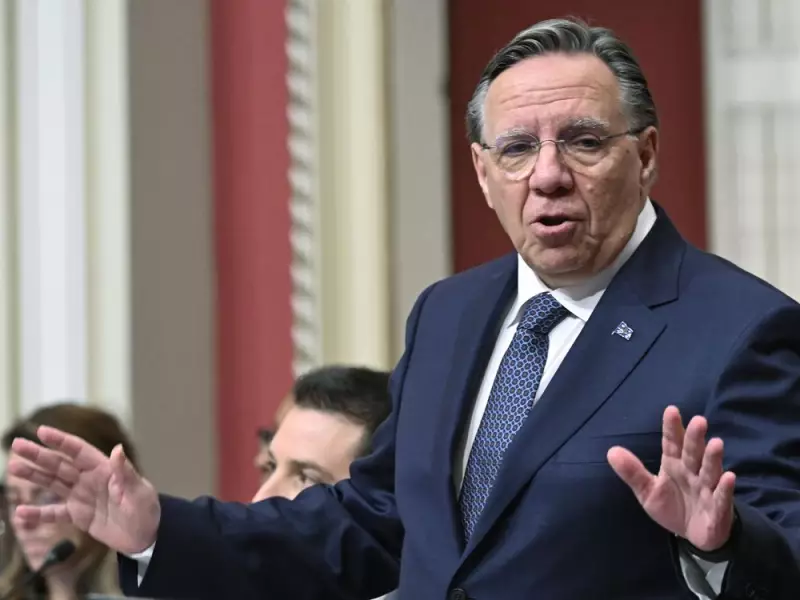
In a move that has dramatically reshaped Quebec's political landscape, Premier Francois Legault announced his resignation from politics on January 14, 2026. His decision comes as public opinion polls indicate his party, the Coalition Avenir Quebec (CAQ), is headed for a severe defeat in the next provincial election.
A Political Landscape Transformed
The premier's departure marks a pivotal moment for Canada's second-largest province, a critical hub for industries like aluminum, aerospace, and metals. Legault stated his resignation was for the good of Quebec, acknowledging a widespread public desire for change. "I can see that many Quebecers currently want change and a change of premier, so I am announcing that, for the good of Quebec, I will be stepping down," he said.
Legault, who co-founded the CAQ in 2011 to offer a new nationalist alternative to the long-standing federalist-separatist divide, first led the party to victory in 2018. His initial platform focused on protecting the French language and closing the economic gap with Ontario. He will remain in office until the CAQ selects a successor.

Collapsing Support and a Separatist Surge
The driving force behind the resignation is a stark collapse in voter support. A recent poll by Pallas Data reveals the depth of the crisis for the governing party. The CAQ now sits at a mere 11% in voting intentions. In a stunning reversal, the sovereigntist Parti Quebecois (PQ) leads decisively with 34% support.
The poll further highlights Legault's personal unpopularity, with 75% of Quebecers holding an unfavourable opinion of the outgoing premier. The Quebec Liberal Party follows the PQ at 24%, with the Conservative Party of Quebec at 16%.
Legacy and Setbacks
Legault's tenure was defined by ambitious, and often controversial, policies. His government enacted sweeping reforms to strengthen French-language laws and overhaul provincial immigration practices, moves that sometimes drew criticism from the business community.
However, his economic agenda suffered a significant blow with the failure of the high-profile Northvolt AB project. The Swedish battery-maker's plans for a $5 billion-plus factory near Montreal collapsed due to the company's financial troubles, resulting in a $270 million loss for the Quebec government.
The administration was also weakened by the departure of two key ministers in 2024: Economy Minister Pierre Fitzgibbon and Health Minister Christian Dube.
With the next provincial election scheduled for October 2026, the political future of Quebec is highly uncertain. The CAQ must now find a new leader to rebuild, while the Parti Quebecois, riding a wave of popular support, is positioned as the favourite to form the next government, potentially reviving the debate on Quebec independence.