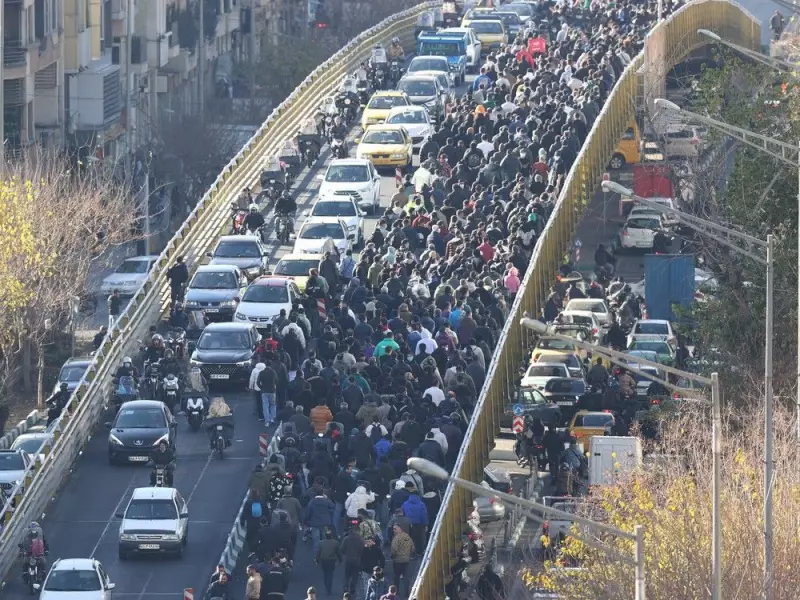
Fresh violence has erupted in Iran, with six people reported killed in clashes between protesters and security forces on Thursday. These are the first confirmed fatalities since a new wave of demonstrations, sparked by soaring prices and a stagnant economy, began sweeping the nation.
Protests Erupt from Economic Despair
The unrest originated on Sunday, December 28, 2025, in the capital city of Tehran. Shopkeepers initiated a strike to protest crippling inflation and a lack of economic opportunity, a move that quickly galvanized public sentiment. The demonstrations have since spread from the capital to several other provinces, reflecting widespread frustration with the country's dire financial situation.
Details of the Deadly Clashes
According to reports from Iran's state-run Fars news agency, the deadly incidents occurred in three separate cities. In Lordegan, located in Chaharmahal and Bakhtiari province, two individuals were killed. The agency stated that protesters threw stones at government buildings, including the provincial governor's office and banks, prompting police to respond with tear gas.

In the neighbouring Lorestan province, three more deaths were reported in the city of Azna. Fars described the incident as an attack on a police station by "rioters" who took advantage of a protest gathering. This terminology is commonly used by Iranian state media to describe demonstrators.
Earlier on Thursday, state television announced that a 21-year-old member of the Basij, a volunteer paramilitary force linked to the Revolutionary Guards, was killed overnight in the western city of Kouhdasht. The deputy governor of Lorestan, Said Pourali, reported that 13 police and Basij members were injured in that city due to stone-throwing.
A Smaller Scale Than Previous Unrest
Analysts note that the current protests appear smaller in scale compared to the massive nationwide movement triggered in 2022 by the death of Mahsa Amini. That earlier wave of anger over women's rights and social freedoms resulted in hundreds of deaths, including dozens of security personnel.
The latest protests began peacefully but gained momentum after students from at least ten universities joined the cause on Tuesday. In a notable attempt to de-escalate tensions, Iranian President Masoud Pezeshkian has acknowledged the "legitimate demands" of the protesters. In a stark warning broadcast on state television, he urged the government to act, stating, "From an Islamic perspective… if we do not resolve the issue of people’s livelihoods, we will end up in hell."
The situation remains volatile as the Iranian government faces the dual challenge of addressing profound economic grievances while maintaining public order, a balancing act that has turned deadly in several cities.