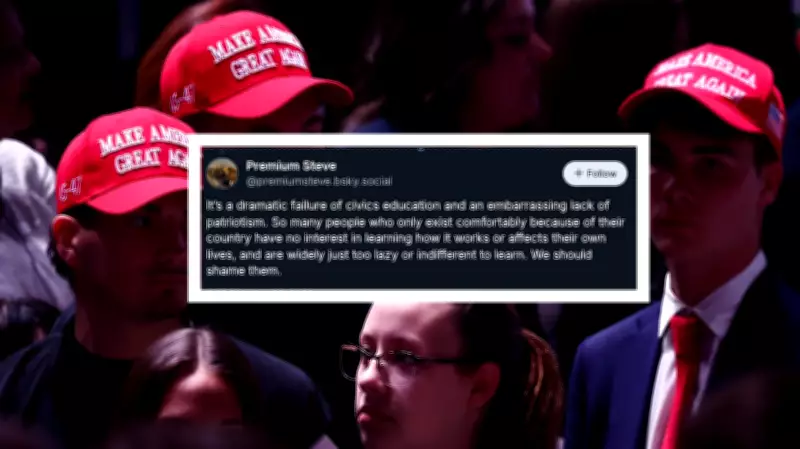
Depending on who you ask, one of the upsides and/or downsides of the modern internet is that it gives us a unique (if voyeuristic) opportunity to look inside the brains of people we have never met and likely never will meet. But following The New York Times' latest attempt to commune with the median Trump voter, some of us might have gazed into the abyss a little too hard.
In the feature published on Monday, 12 Trump voters between the ages of 19 and 65 were given the opportunity to answer questions about how they felt the president was performing at the job they elected him to do, providing feedback on everything from his immigration enforcement, DOGE cuts, the Ukraine and Iran wars, and affordability. Expressing that they felt frustrated, annoyed, discouraged, betrayed, and apathetic about the country these days, these voters offered a glimpse into the worldviews of citizens who had high hopes for Trump's second term. Ultimately, a majority of them, when given the chance to assign Trump a letter grade for his performance so far, gave him a D or an F, with one lone semi-believer giving him a C.
In the days since the article was published, the rest of the internet could not help but gawk. Some items on their Trump 2.0 wish lists did not add up, revealing some misunderstandings or miseducation. In response to the story, a recurring theme emerged: ... but that is not how that works? and open the fucking schools upon reading what some of these voters said they earnestly believed would happen when Trump returned to office.

Key Misunderstandings Highlighted
Franceska, a 26-year-old deckhand, said, I thought that they would get rid of taxes so we would get our full paycheck instead of just half of it. She was credited with dropping the final boss co-worker belief, inspiring Sad Keanu-level dread in one Bluesky user. Argenis, a 35-year-old in HVAC sales, showed a similar misunderstanding of property taxes that also raised eyebrows, particularly from those who like having well-funded community resources like schools and fire departments.
John, a 62-year-old packaging specialist, counted among Trump's accomplishments initiating the ending of the penny and getting us out of the World Health Organization (WHO) and the Paris climate agreement, concluding those expenses were accounting for a lot of our budget money. However, data shows the penny costs were about 0.00003% of the U.S. federal budget, per CNBC; U.S. contributions to the WHO made up about 0.007%; and pledged funding for the Paris climate agreement before Trump withdrew would have been about 0.2% of the budget.
Online Reactions and Civics Education Concerns
One reader found John's assessment of the division of budget money to reach Lucile Bluth levels of out of touch, and others vented similar frustrations. For quite a few users, it brought up feelings about the state of civics education (or the lack thereof) in the U.S. This is not necessarily a new gripe, as the National Association of State Boards of Education (NASBE) previously noted that data on the state of civics education in the United States was less than proficient.
From the 2022 National Assessment of Educational Progress (NAEP) exams, data showed that only 22% of eighth grade students across the country are working at the Proficient level in civics, via the test that examines knowledge of democratic citizenship, government and American constitutional democracy. While proficiency is the goal, about a third of students are not meeting even the NAEP Basic benchmark, meaning they likely cannot describe the structure and function of U.S. government, Martin R. West, academic dean and professor of education at the Harvard Graduate School of Education, wrote for the NASBE website. Average scores are trending downward, with score drops for lower-performing students driving the decline — a sign of growing inequality in U.S. schools. What is more, students' confidence in their civic knowledge and skills is down. They sense there is a problem.

While there is obvious sympathy and empathy for children struggling to grasp these concepts, some users expressed difficulty extending that same grace to other adults who seemed comfortable being loud and wrong at such a big age. Luckily, there seems to be an earnest desire to see this course-corrected for them (and, by extension, all of us) in the future. But, given the current leadership of our Department of Education, we might just have to be patient.