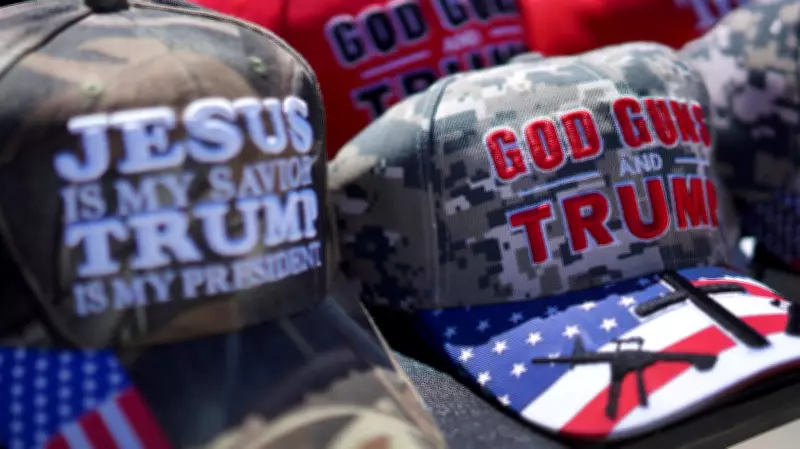
For countless Americans nurtured in conservative Christian settings, faith traditionally represented a deeply personal conviction and a source of community—distinct from overt political alignment. However, over the last decade, the once-clear boundary between religious belief and political ideology has profoundly blurred. As pulpits increasingly echo with endorsements for political candidates and worship services blend hymns with patriotic anthems, congregations have splintered over issues ranging from public health mandates and immigration to race and cultural morality.
A Viral Moment Crystallizes a Growing Divide
A viral video by nurse and content creator Jen Hamilton, juxtaposing a reading of Matthew 25 with a critique of MAGA politics, captured a conversation simmering for years. It highlighted a painful reality: when faith and ideology collide, some believers feel compelled to walk away, even at the cost of losing the communities that shaped them. One commenter poignantly reflected, "I grew up Catholic but left the church because of the toxic views and opinions on ‘morality.’ If most Christians were like you, I reckon I’d go back." For many, this shift toward political entanglement has been disorienting; for others, it has been spiritually devastating, transforming what once felt like a moral home into a battleground.
Early Lessons: The Fusion of Faith and Nationalism
Anna Rollins, author of "Famished: On Food, Sex, and Growing Up as a Good Girl," recalls a childhood immersed in rules where faith was paramount. Growing up Southern Baptist, she observed Christianity presented as nearly inseparable from Republican identity. "Faith and freedom were often talked about in the same breath," Rollins notes. "We often sang patriotic songs in church services, in addition to hymns. Nationalism was tightly woven in with Christianity."

Deirdre Sugiuchi, a Georgia-based writer with an upcoming memoir "Unreformed" about her time in a white evangelical reform school, describes a darker dimension. "MAGA Christianity is a cult. I know because I was in it," she states, emphasizing that leaving such environments can require everything, as many believers are effectively brainwashed. Sugiuchi expresses terror over the merging of politics and Christianity, warning that silence allows others to be swept into systems of control.
The Moral Framework of MAGA Christianity
Cara Meredith, author of "Church Camp: Bad Skits, Cry Night, and How White Evangelicalism Betrayed a Generation," recalls a formative message: "Vote Republican. There was no other option." This perspective framed political choice as a matter of good versus evil, with God clearly on one side. Critics argue that what is often termed "MAGA Christianity" represents a distinct moral framework—one prioritizing obedience to authority and nationalism over traditional Christian values like love, service, and community. This shift, they say, subordinates Jesus' teachings on caring for the poor and marginalized to a political-tribal agenda.
Amy Hawk, author of "The Judas Effect: How Evangelicals Betrayed Jesus for Power" and a self-described "ex-vangelical," points to Trump's treatment of women as contradictory to her ministry work. "It made no sense for me to support Trump," she says, noting that the embrace of Trumpism among white evangelicals became "too great to ignore," ultimately pushing her family out of the church.
How the Cracks Began to Form
The very structures that fused faith and politics also sowed seeds of doubt. For Rollins, deeper questioning arose from reading the Bible. "Reading Scripture made me see that Christianity was not about aligning oneself with a nation-state," she explains. "Jesus was killed, in part, because people wanted him to act in [the] service of political movements."
For Sugiuchi, a turning point came after years of trauma. At 15, she was sent to Escuela Caribe, an evangelical reform school, for failing to be a "subservient adolescent female." The abuse she endured was justified in the name of Jesus. Her perception shattered upon reading Julia Scheeres' memoir "Jesus Land," which detailed similar experiences. Realizing her silence had contributed to ongoing harm, Sugiuchi helped shut the school down. Today, she maintains a private faith but has no connection to organized religion.

The Distortion of Christianity
Tia Levings, author of the New York Times bestseller "A Well-Trained Wife: My Escape From Christian Patriarchy," describes MAGA Christianity as the overlap between authoritarian Christianity and Christian nationalism. "Right now that’s close to a perfect circle," she tells HuffPost, calling it a malformation since Jesus was neither nationalist nor authoritarian. Levings attributes this distortion to churches failing to protect congregations from nationalist influence and decades of authoritarian parenting shaping family life.
Reflecting on why many remain tied to these communities, Rollins observes, "Some people identify as MAGA because they have been taught that hyper-individualism, nationalism and white supremacy are the same as Christianity—and I think this is tragic. But I also think that many people identify as MAGA because they do not feel compelled by the alternative."
What Finally Prompted Their Departure
Leaving was rarely a swift decision; it involved years of wrestling with faith in a culture where religion and nationalism had fused. "Leaving costs nearly everything," Levings says. "Although that loss may come as a gradual spiral, step by step. The twist is that there’s so much hope and determination to live an authentic life that you realize you’re worth the fight."
For some, a sudden jolt—a sermon or social media post—forced confrontation with dissonance. For others, it was a slow erosion of unease with "us versus them" rhetoric. Hawk describes the shift as gradual: "It started to feel like the church wasn’t about faith anymore. It was about fear and control, about who was in and who was out."
Meredith notes that for white evangelicals, waking up often involves recognizing issues of justice and privilege. Her disentanglement took 20 years, spurred not by one monumental event but by "a series of lots of little things that make you realize, ‘Hey, something’s not right.’"
Triggers for Disengagement
Common triggers cited include moral dissonance between Gospel ethics and political messaging, political trauma within congregations, concerns about racial and immigrant justice, and eroding trust in church leadership. Hawk observes, "In the ten years since Trump came on the scene, I have learned that white evangelical spaces don’t follow Jesus as closely as they pretend to. In fact, there has been a mass indoctrination into the Republican Party that looks absolutely nothing like the Christ they claim to serve."
The Exit Costs and Search for Belonging
Meredith reflects on the profound loss: "When you’re in, you’re in. But when you’re out, you’re out. You’re cast to the side." The community that once offered support—praying, celebrating milestones, providing meals—vanishes, leaving a void in soul, calendar, and social connections.
Some, like Rollins, have redefined their faith, retaining what feels authentic while discarding elements like prosperity gospel, perfectionism, white supremacy, and hyper-individualism. "I’m still a Christian," she asserts. "I think that Christianity is a beautiful religion that speaks to the problem of evil but also offers hope and grace."
Hawk finds her faith freer outside those spaces: "I don’t care what anyone thinks of me. My favorite verse now is Galatians 5:1, which I believe is an indictment against religious structures, rules, and conformance."
Hope for the Future and Words of Encouragement
Rollins hopes the broader church will confront its contradictions, preaching not just personal morality but also Jesus' teachings on caring for the poor, orphans, and foreigners. Meredith emphasizes the power of belonging: "You belong, because you’re human. That’s it." She encourages those questioning to explore boldly, while Sugiuchi advises seeking progressive churches, reading on religious trauma, and connecting with supportive communities. "Know you are not alone," she says. "You can be free."