The Vancouver Canucks have never won the NHL Draft Lottery and have lost positioning on four occasions, including slipping from second to fifth in 2017 and third to fifth in 2016. They also dropped from sixth to seventh in 2018 and ninth to tenth in 2019. This history of misfortune may be rooted in the expansion era, when the Canucks lost a wild roulette-wheel spin in 1970, setting the franchise up for decades of draft mystery. That misread awarded the first-overall pick to the Buffalo Sabres, meaning Vancouver missed out on Hockey Hall of Fame inductee Gilbert Perreault and settled for Dale Tallon, who played three seasons in Vancouver before being traded.
Now, the Canucks have the best bingo-ball odds at 25.5 per cent to secure the first-overall lottery selection on May 5, with the opportunity to target highly productive winger Gavin McKenna. However, they also have an 18.8 per cent chance of selecting second, and their most likely outcome is dropping to third with a 55.7 per cent shot. That could spark a great debate over whether the Canucks should target centre Caleb Malhotra, arguably the best pivot available for the NHL Draft on June 26-27, or budding blueliners Keaton Verhoeff and Chase Reid.
Why Defence May Be the Priority
According to long-serving NHL prospects scout Shane Malloy, who deemed the top-10 potential of the 2026 NHL Draft as good because there are five defencemen, there is no debate. Malloy, author of The Art of Scouting and a regular on Hockey Prospect Radio, believes that if the Canucks do not land McKenna, their focus should shift to the back end, even at No. 2, passing on Swedish scoring winger Ivar Stenberg. The reasoning is supply and demand: NHL teams need to build from the blue-line, and elite defenders are rare and highly coveted at the draft.

The Canucks could argue they are on a path to future prominence with defencemen Zeev Buium (20), Tom Willander (21), and Elias Pettersson (22) in the development pool. However, they need support for a roster rebuild that could take several years before the Canucks return to playoff potential. Malloy stressed, “They should take a defenceman — they’re missing a piece.” He added that two of the available defencemen could become a No. 1 and the other three a No. 2, and drafting a first-pairing defenceman supersedes anybody else. In his eyes, Reid and Verhoeff are tied, but when pressed, Malloy said he would select Verhoeff over Reid if McKenna is off the board.
Keaton Verhoeff: A Potential Top-Pairing Blueliner
Verhoeff, standing 6-foot-4 and weighing 218 pounds, is a right-shot defenceman who did not look out of place as a 17-year-old NCAA rookie. He acclimated quickly at North Dakota with strong down-low defending and projects as an Aaron Ekblad type — a reliable rearguard who can play in the top pairing and eventually form a formidable union to insulate the speedy Buium. This would allow Willander to grow alongside Pettersson. As Malloy put it, “You set up your defence core for a decade.”
Gavin McKenna: The Highest Offensive Ceiling
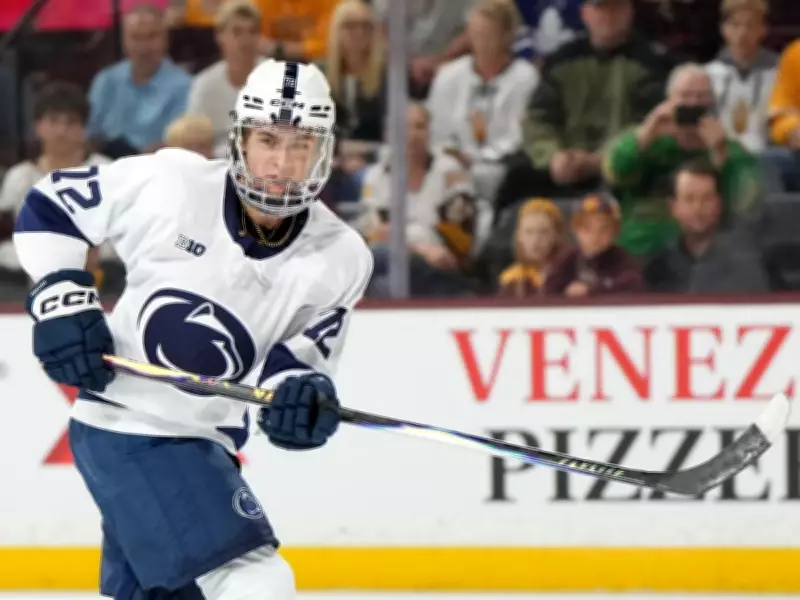
As for McKenna, it is a no-brainer first overall selection. Aside from an envious skills package that transferred from Medicine Hat to Penn State, the Whitehorse native would be a boon to the business side, especially in a long rebuild with empty seats and rising ticket prices. McKenna had 14 points (4 goals, 10 assists) in seven 2026 world junior hockey championship games and 129 points (41 goals, 88 assists) in 56 WHL games in 2024-25. Malloy emphasized, “He’s a guy they can market. When you’re drafting that high, the business side is a consideration. He has the highest offensive ceiling of anybody in the draft.”
McKenna entered college as a 17-year-old freshman (now 18), while the average age of a junior in the CHL is 18 and in college it is 21.5. This makes a tremendous difference for a young offensive player, as the opposition is bigger, faster, stronger, and more mature, and plays a structured game. Malloy noted that you cannot compare a player in the WHL putting up points against 18- and 19-year-olds versus a 17-year-old college freshman producing in a tough conference like the Big Ten.

Canucks Draft Pick Priorities
- 1. Gavin McKenna, LW, 5-11, 170 lbs., Penn State (NCAA) — GP: 35, G: 15, A: 36, PTS: 51. Scout says: “His two traits are hockey sense and ability to see the play before it develops and make the correct play consistently. His greatest skill is creating time and space.”
- 2. Keaton Verhoeff, RSD, 6-4, 212 lbs., North Dakota (NCAA) — GP: 36, G: 6, A: 14, PTS: 20. Scout says: “He’s going to play at 225 pounds, no problem. Think about Aaron Ekblad, a big right-shot defenceman. How would the Canucks look with a guy like that?”
- 3. Chase Reid, RSD, 6-2, 187 lbs., Sault Ste. Marie (OHL) — GP: 45, G: 18, A: 30, PTS: 48. Scout says: “Could quarterback the second power-play unit, which reduces the top unit responsibility to play more 5-on-5 and also kill penalties. You have to look at all that strategically.”