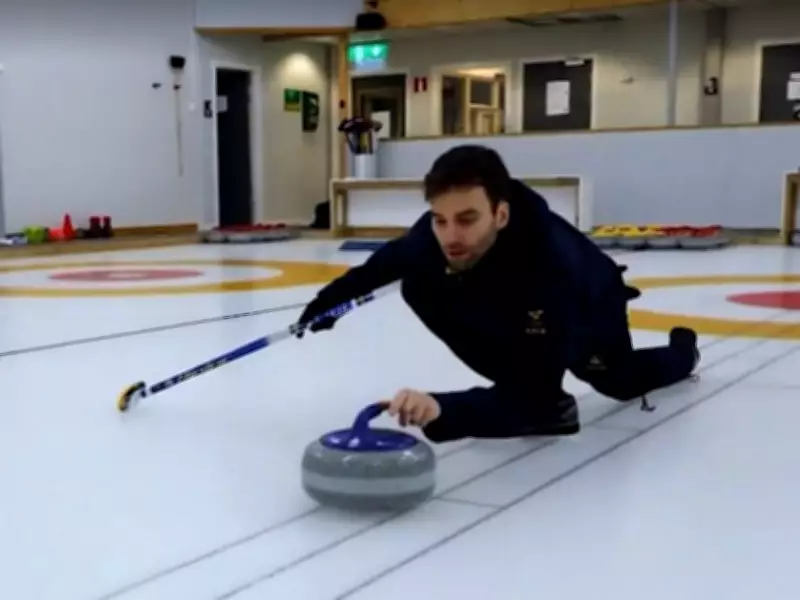
Swedish Curler's Demonstration Video Fuels Olympic Controversy
Swedish curler Oskar Eriksson has reignited the heated double-touch controversy from the Winter Olympics with a new demonstration video that has circulated online, directly challenging Canadian curler Marc Kennedy's actions during their Milano-Cortina matchup earlier this year.
The Controversial Video Demonstration
In a video posted on March 27 by Swedish broadcaster SVT, Eriksson demonstrates how even a slight double-touch can significantly alter a curling stone's trajectory. The Swedish curler, who serves as third on Niklas Edin's rink, specifically addresses the incident that occurred during preliminary round competition at the Winter Olympics.
"At our level, just altering a stone by five centimetres on the other side, knowing how little you need to do to make that correction, is also a skill," Eriksson states in Swedish, according to CBC's Verity Stevenson.

Eriksson didn't stop at technical demonstration. He added pointed commentary about the Canadian team's approach, suggesting they were "evil" and stating, "I'm not taking anything away from the fact that they are good curlers. But I wish they had just chosen to play the same way that all other teams try to do. Evil unfortunately wins sometimes."
Revisiting the Olympic Confrontation
The video comes approximately six weeks after the intense on-ice argument between Eriksson and Kennedy during their Olympic match. The confrontation began when Eriksson accused Kennedy of touching the rock after his release, a violation known as double-touching.
Kennedy defended his actions, insisting he maintained contact with the stone throughout the delivery. The exchange grew heated with Eriksson threatening to show video evidence after the game and Kennedy responding with, "How about you walking around on my peel dancing around the house here."
This wasn't the only double-touch controversy involving Canadian curlers at the Games. Rachel Homan, skip of Canada's women's team, also faced similar accusations during Olympic competition.
Understanding the Double-Touch Rule
The World Curling rulebook contains specific provisions regarding stone delivery. According to official regulations, "a stone must be clearly released from the hand before it reaches the hog line at the delivery end. If the player fails to do so, the stone is immediately removed from play by the delivering team."
However, another rule creates ambiguity, stating that "a double touch by the person delivering the stone, prior to the hog line at the delivering end, is not considered a violation." This technical distinction lies at the heart of the ongoing controversy.
Recent Developments and Responses
While Canada's men's team ultimately won the Olympic gold medal, Eriksson may have gained some measure of satisfaction recently. Team Sweden defeated Canada, skipped by Matt Dunstone, at the men's world championship just this past Sunday.
According to CBC reports, Kennedy and Team Canada have yet to comment on Eriksson's latest video demonstration. The renewed attention to this technical aspect of curling has sparked debate among fans and experts about:
- The interpretation of double-touch rules at elite competition levels
- The sportsmanship implications of such technical violations
- How video evidence should be used in officiating decisions
- The lasting impact of Olympic controversies on international curling relations
The controversy highlights the fine margins that separate victory from defeat in elite curling, where millimeter adjustments can determine championship outcomes. As the curling community continues to discuss the implications of Eriksson's video, the incident serves as a reminder of how technological advancements and social media have changed how sports controversies unfold and persist long after competition concludes.