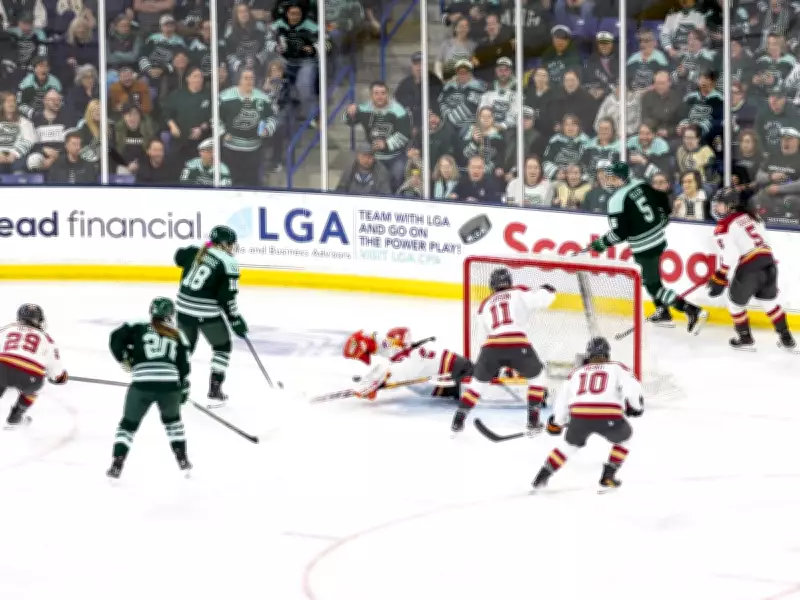
The penalty-box benches barely had time to cool as a steady stream of players cycled through them in the opening game of the PWHL semifinal between the Ottawa Charge and the Boston Fleet. The game can only be described as a gritty, aggressive and intensely physical contest that ended in a 2-1 Boston win.
A Game Defined by Penalties
Officials called penalties on 10 different plays throughout the game, including a game misconduct to Boston's Rylind MacKinnon for a hit to the head on Ottawa's Gabbie Hughes. Six of those infractions came in the first period alone.
"Certainly, there was a lot of special teams," head coach Carla MacLeod said post-game. "We had to use our fingers at one point to figure out what's the situation we're going to be in and how long."

"But at the end of the day, it's two really great hockey teams trying really hard to win a hockey game, and so … you're going to have to kill some penalties and get some power-play looks, and that's just what this time of the year brings."
Special Teams Performance
It was a game where special teams could only be expected to dominate the storylines. A well-timed Charge power-play goal could have made the difference to force overtime. Instead, both teams squandered their chances.
Yes, Ottawa's lone goal did come on the power play, when a Rory Guilday shot deflected off Jocelyne Larocque and past Aerin Frankel, but the overall performance was far from convincing. The Charge power play went 1-for-6 and failed to generate a single shot on net during multiple advantages, struggling to solve Boston's impenetrable penalty kill.
The Fleet wasn't any better with the extra skater, going 0-for-5 as Ottawa's success on the penalty kill was a bright spot in the game.
"Our penalty killers, we're all in on it," MacLeod said. "Those are key moments, and those are situations where you have to dig yourselves out."
Impact on Series Flow
In a series defined by physicality where intensity and penalty minutes can only be expected to ramp up, special teams could easily become the difference maker. But Game 1 felt disjointed, with plays disrupted by frequent whistles and lines shuffled by trips to the penalty box, preventing Ottawa from settling into a post-season rhythm.
"I think you just have to see the good in it," Larocque said when asked if the team's flow was disrupted. "As soon as we're on the kill, we're like, 'we got this,' and there's that confidence in sticking to the systems."
Regular-Season Context
If the regular-season series between Boston and Ottawa is any indication, this kind of struggle isn't surprising. Across four games, the Charge and Fleet combined for 27 power-play opportunities — 14 for Ottawa and 13 for Boston. Yet, each team scored just one power-play goal apiece.
As the series progresses, improving the power play could be the key for Ottawa to even the score and challenge the favored Fleet.