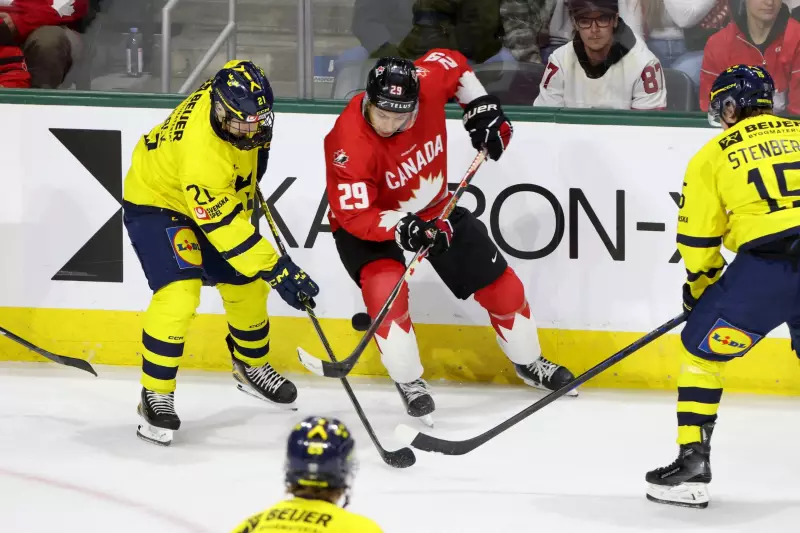
The preliminary round is complete, and the road to gold has narrowed for Canada's national junior team at the 2026 IIHF World Junior Championship in Minneapolis. With the margin for error now gone in the single-elimination knockout stage, the team's success will hinge on its standout performers, who have carried the load through the early games.
Michael Hage: Canada's Offensive Engine and MVP Candidate
Forward Michael Hage has been the most consistent and dynamic force for Canada throughout the tournament. While questions swirled about the team's overall performance after its first two contests, the University of Michigan sophomore has been a constant source of production. His eight points tie him for the tournament scoring lead, and he has recorded at least one point in every game since pre-tournament play began against Sweden.
Hage's versatility has been key. He is far from a one-dimensional player, finding different ways to impact the score sheet each night. He showcased elite playmaking vision with two primary assists on linemate Brady Martin's goals in a crucial game against Finland. Later, he proved his scoring touch by netting the game-winning goal in overtime against Latvia.

"He always makes the right play," said linemate Brady Martin. "If you get open, he'll find you. His hands and IQ take him a long way." With his all-around offensive game driving Canada's attack, Hage has built a compelling case for tournament Most Valuable Player honours.
The High-Risk, High-Reward Brilliance of Zayne Parekh
On the blue line, Zayne Parekh has embodied the duality that has defined his junior career: breathtaking offensive skill paired with occasional defensive lapses. The defenceman is nobody's idea of a safe, stay-at-home player. One shift might feature a stunning two-zone pass onto Tij Iginla's tape for a breakaway goal; the next could see him caught out of position on an odd-man rush.
Yet, his offensive contributions have been undeniable and historic. On New Year's Eve, Parekh became the first Canadian defenceman to record at least eight points by the end of the preliminary round since Ryan Ellis in 2011. He sparked Canada's offence against Finland with a smart, low glove-side goal after recognizing the goaltender was slightly out of position. Teammate Michael Hage later revealed Parekh had called his shot before taking that shift.
His ability to generate offence from the back end is nearly unmatched in this tournament, perhaps only rivalled by the injured American Cole Hutson. Parekh's flashes of brilliance clearly illustrate why he earned games with the NHL's Calgary Flames earlier this season.
Brady Martin: The Perfect Complementary Force
While garnering attention for a pregame donut ritual, Nashville Predators prospect Brady Martin has commanded notice on the ice as the ideal linemate for Hage. The fifth overall pick has used his physicality to plant himself in front of the net, capitalizing on Hage's playmaking with a pro-level shot that is deadly in tight spaces.
Martin thrives in gritty, physical games and has embraced a net-front role on the power play for Team Canada, a slight deviation from his usual position with the OHL's Soo Greyhounds. "I don't play net front often, but when I do it, I'm pretty good," Martin told TSN. "I love it. I mean, I'll stand in front of the net and I'm not scared of it."
Beyond his finishing touch, Martin is also a poised passer, effectively finding Hage and Gavin McKenna with smart plays. His ability to elevate his game when the stakes are highest is a promising sign for Canada as it enters the win-or-go-home quarterfinal against Slovakia on Friday.
With the preliminary hurdle cleared, Canada's quest for a world junior championship now enters its most critical phase. The performances of stars like Hage, Parekh, and Martin will determine how far this team can go in Minneapolis.