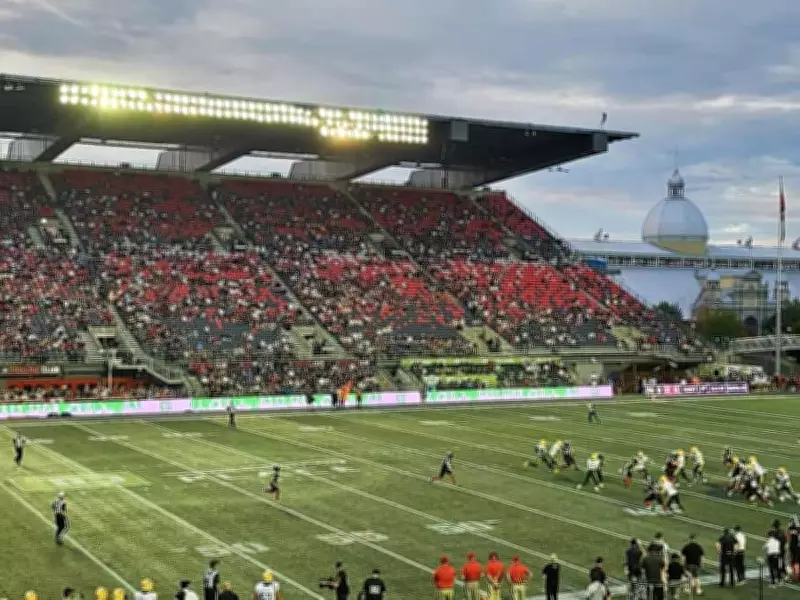
If 90 per cent of the sports teams in a league qualify for the playoffs, what exactly is the regular season for? That is the question Canadian football fans might be asking following the recent announcement by the CFL that, starting in 2027, eight of the league’s nine teams will advance to the post-season.
A Shift in Playoff Structure
The league is citing more meaningful games, more fan engagement, and more teams staying alive longer into the year as pluses. But there is another way to look at it: getting in really does not mean much — and may, in fact, make more games matter less. This feels less like innovation than survival.
Last year, league commissioner Stewart Johnston noted that only two CFL teams had turned a profit the previous season. “That’s not a sustainable business model,” he said. And perhaps that is of particular interest in Ottawa these days, where two professional sports franchises appear to be heading in very different directions and, increasingly, at very different speeds — and where the city may be struggling to keep up with the fortunes of each.

Two Leagues, Two Trajectories
One league — the CFL — is not-so-quietly lowering the bar to keep teams, and the league itself, relevant. It has adjusted rules and formats in an effort to, in Johnston’s words, “win in the attention economy.” The other — the PWHL — is finding that its problem is not too little interest, but too much.
In remarkably little time, the Professional Women’s Hockey League has become one of the city’s hottest properties in sports. The Ottawa Charge have drawn crowds and a level of enthusiasm that most teams, and leagues, would kill for. In the attention economy, it is doing gangbusters.
Lansdowne 2.0: Backing the Wrong Horse?
And yet, when it came time to plan the future of Lansdowne Park, the city effectively sent two very different messages. It went to considerable lengths to “right-size” the site for the CFL and OSEG — the Redblacks’ owner — ultimately relying on Redblacks projections that may have been overly optimistic. But when it came to the arena, “right-sizing” meant reducing capacity to the point where the PWHL and Charge effectively said, “We can’t play here. It’s too small.”
The result is that the team has had to look elsewhere — not because of a lack of demand, but because the plan did not anticipate its success. So here is the $419 million question: why is the city investing hundreds of millions in a Lansdowne 2.0 project that is backing a dying league, and potentially evicting a winning one?
The Charge's Search for a Home
The Charge are looking for a new home. Throughout these PWHL playoffs, their home games will be at the Canadian Tire Centre — an arena that solves the capacity problem while creating another: geography. For many fans, it is a long haul. For a team whose early success has been partly built on accessibility, it is not ideal, and season ticket-holders I have spoken with are not excited by the prospect of the team leaving downtown.
The contrast between the two leagues could not be starker. The CFL is diluting its product to stay afloat, while the PWHL is thriving and outgrowing its venue. Ottawa’s investment in Lansdowne 2.0 appears to be a bet on the past, not the future.