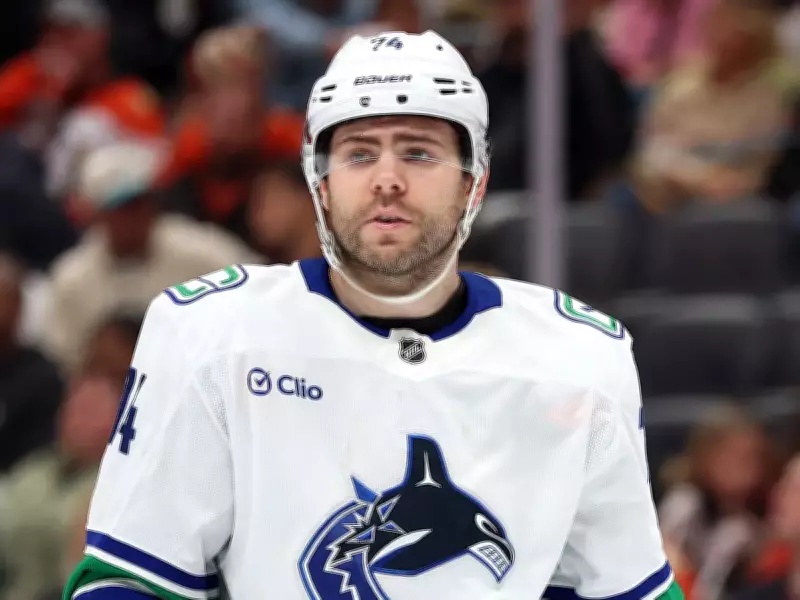
Vancouver Canucks Face Uphill Battle in NHL Rebuild Process
The conclusion of each NHL season brings a mixture of emotions across the league, with only one franchise ultimately celebrating a Stanley Cup victory in June. For numerous teams, the experience ends in frustration with early playoff exits during late April or early May. This reality often prompts significant roster adjustments as organizations strive to enhance their competitive standing.
Canucks Navigate Complex Rebuilding Challenges
The Vancouver Canucks currently find themselves navigating a delicate rebuilding phase that requires balancing immediate improvements with long-term strategic planning. The team's offensive struggles were particularly evident this past season, finishing 31st in league productivity. Addressing this pop-gun offense represents a crucial step toward alleviating the pain associated with transitioning from postseason spectators to consistent contenders.
Traditional rebuild philosophy cautions against mortgaging the future to solve present problems, a lesson the Canucks learned painfully when they surrendered the ninth-overall selection in 2021. That pick became Dylan Guenther, who scored 40 goals this season for the Utah Mammoth at just 23 years old. This serves as a stark reminder of the perils associated with insufficient long-term planning.

Veteran Leadership and Production Challenges
As losses accumulate and empty seats potentially become more visible at Rogers Arena next fall, Canucks ownership may grow increasingly impatient. The hockey operations department faces pressure to improve the on-ice product while simultaneously allowing young, potential-packed players to develop amid the competitive grind.
The concept of getting younger and better simultaneously sounds appealing in theory but proves considerably more challenging in practice. Restoring the Canucks to competitive relevance requires veteran leadership, consistent production, player health, and organizational patience.
Leading goalscorer Jake DeBrusk endured a trying season that saw him net 23 goals, with 19 coming on the power play to rank third overall in that category. Other offensive contributors included Brock Boeser, who needed a late surge of four goals in his final ten games to reach 21, Drew O'Connor achieving a career-high 17 goals, rookie Linus Karlsson managing 15, and Elias Pettersson experiencing a significant drop to just 15 goals.
DeBrusk's Perspective on the Rebuilding Process
At 29 years old, DeBrusk has reached a career stage focused on winning and pursuing Stanley Cup championships. Embracing a rebuild proves particularly challenging for veterans accustomed to postseason success, as DeBrusk experienced during his tenure with the Boston Bruins where he led the team in playoff scoring.
DeBrusk's $5.5 million salary cap hit extending five more seasons would attract interest from multiple suitors should the Canucks consider trade options. However, his recent comments suggest commitment to the Vancouver organization despite the difficulties.
"After every season, you try to look back and figure out what went right and wrong," DeBrusk stated during year-end player availability. "Obviously, this year was tough on all of us — young and old — and it's not what I expected. At the same point, if I played better, we might be in a different position."
He continued: "It's easy to embrace a rebuild when you have young potential on the back end and some younger forwards who took steps. Lots of things have to go right for a winning team and I've seen it and I kind of got used to it. Everybody needs to be a piece and we need to figure out where those puzzle pieces are and improve."
"For us older guys, it's about getting back to the playoffs, or at least a better place. Nobody is going to come in and save the day. We all need to be better."
Learning from Successful Rebuild Models
The Anaheim Ducks present an instructive case study, qualifying for the playoffs for the first time in seven years through a hybrid rebuild approach combining astute drafting with strategic trades to complement a young, emerging core. Their roster features ten draft picks, including six players aged 23 or younger, positioning them as an emerging annual playoff fixture.

Anaheim's success stems from hitting on first-round selections including Leo Carlsson, Mason McTavish, Pavel Mintyukov, and Beckett Sennecke. A prudent trade two years ago that sent defenceman Jamie Drysdale and a second-round 2025 draft pick to Philadelphia brought Cutter Gauthier, who exploded for 41 goals this season at age 22.
The Montreal Canadiens offer another compelling example of a storied franchise embracing short-term rebuild pain for long-term gain. After initiating their youth movement four years ago, the Canadiens have returned to the playoffs for the second consecutive spring featuring 51-goal scorer Cole Caufield (25) and 30-goal contributor Juraj Slafkovsky (22).
Montreal's approach involved not merely accumulating draft picks but strategically identifying trade targets of players who hadn't yet reached their potential with previous clubs, benefiting from changed environments and improved organizational fits.
Organizational Continuity and Development
If the Canucks demonstrate genuine commitment to their franchise transformation, organizational familiarity may prove more beneficial than disruptive. This perspective supports promoting Abbotsford general manager and Canucks assistant GM Ryan Johnson, 49, to supplant the recently fired Patrik Allvin as general manager.
Similarly, Manny Malhotra, 45, presents a compelling candidate to assume coaching responsibilities given his understanding of the organization, ownership, market dynamics, and expectations. Their experience guiding the AHL affiliate in Abbotsford to the Calder Cup championship last June demonstrated proficiency in developing prospects while maintaining competitive success.
Although this season saw the Abbotsford team miss the postseason due to injury challenges and four key players transitioning to NHL roles with the parent club, Johnson and Malhotra gained valuable insights from the experience. Six players who previously developed under their guidance in Abbotsford project to be on the Canucks roster for the 2026-27 season, illustrating the importance of organizational continuity in player development.
As the Vancouver Canucks continue navigating their challenging rebuild journey, lessons from successful franchises combined with veteran leadership from players like Jake DeBrusk and potential organizational promotions could help smooth the rough road back to NHL respectability and postseason contention.