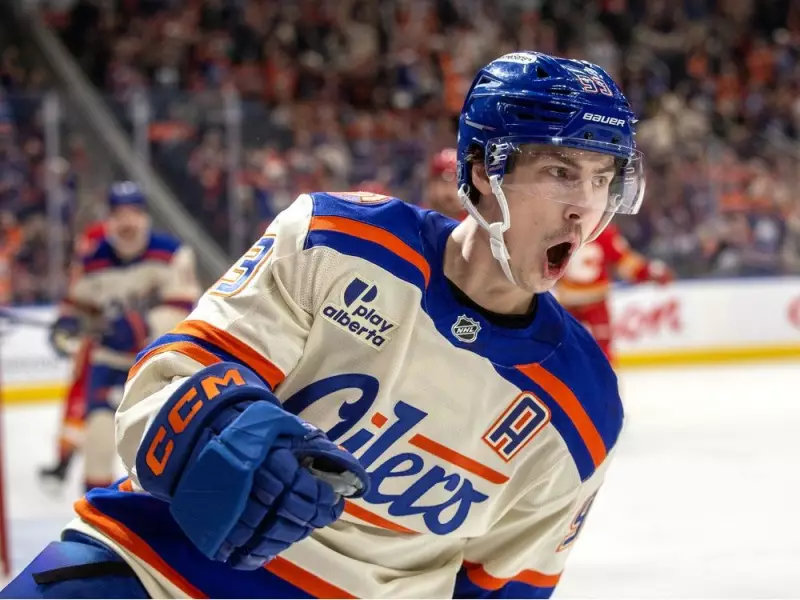
Edmonton Oilers head coach Kris Knoblauch is staring down one of the most difficult and potentially season-defining decisions of his tenure. The dilemma revolves around whether to dismantle one of the National Hockey League's most dominant forward lines in an attempt to salvage a deeply flawed bottom-six forward group.
The Practice Lines That Sparked Concern
Practice lines reported by Oilers insider Bob Stauffer on Sunday, January 3rd, 2026, did little to calm the nerves of a concerned fanbase. The forward combinations presented a stark picture of the team's imbalance, highlighting the massive gulf in performance between the top and bottom of the roster.
The lines showed Ryan Nugent-Hopkins, Connor McDavid, and Zach Hyman together on the top unit. However, the proposed bottom two lines featured a mix of veterans and rookies that have struggled mightily throughout the first half of the season.

A Statistical Chasm That Demands Action
The core of the problem is not a matter of perception but of cold, hard statistics. Through the team's first 42 games, a shocking imbalance has been revealed when McDavid and Leon Draisaitl are not on the ice.
Without their two superstars, the Oilers have been outscored 44 goals to 19 at even strength. This -25 goal differential stands in jarring contrast to the team's performance with one or both of McDavid and Draisaitl playing, where they hold a positive 63 goals for to 55 against advantage.
This statistical canyon has led many fans and analysts to propose a radical solution: spreading the elite talent. The popular theory suggests deploying McDavid, Draisaitl, and Ryan Nugent-Hopkins as centres on three separate lines to create strength down the middle.
The Allure and Risk of RNH at Third-Line Centre
Moving Nugent-Hopkins to the third-line centre role is particularly tempting. His performance as a centre during the 2025 playoffs was arguably the best of his career, especially defensively. He has developed the stick strength, battle level, and positional awareness that were sometimes lacking during his earlier years as an NHL centre.
Such a move would also open a coveted spot on a top line for a promising rookie like Ike Howard or Quinn Hutson, potentially accelerating their development with elite linemates.
However, the risk is monumental. It would require Knoblauch to break up a line that has been nothing short of spectacular since it was first assembled on November 29th, 2025, in a game against the Seattle Kraken. That night, with RNH returning from injury, the trio of McDavid, Nugent-Hopkins, and Hyman each recorded a goal and an assist in a 4-0 victory.
The Unparalleled Success of the Top Line
In the 17 games the trio has played together, their dominance is undeniable. In 158 minutes of 5-on-5 play, they have outscored opponents 11 goals to 6. Their individual point production has been explosive: Hyman with 12 goals and 8 assists, McDavid with 15 goals and 23 assists, and Nugent-Hopkins with 6 goals and 11 assists over that span.
Advanced metrics tell an even more compelling story. Compared to the season's first 25 games—where both Hyman and RNH missed significant time—their even-strength play has skyrocketed. RNH's rate of generating Grade A shots improved from +1.2 to +2.3 per game, Hyman's from +2.3 to +3.5, and McDavid's from +2.0 to an astounding +3.8 per game.
This line is, quite simply, killing it. It represents one of the few consistently excellent elements for the Oilers this season. The fundamental question Knoblauch must answer is: why mess with such profound success?
The Inescapable Playoff Reality
While sticking with the explosive top line is a completely understandable and defensible position for any coach, the long-term reality is grim. The historical data from the NHL playoffs is unequivocal: teams with such a profound weakness in their bottom-six forward groups rarely find postseason success.

If the massive goal differential issue is not addressed, the Oilers' Stanley Cup aspirations will likely be extinguished quickly, potentially with another first-round playoff exit. The bottom two lines getting consistently "caved in," as the statistics show, is a recipe for playoff failure, no matter how brilliant the top line performs.
Kris Knoblauch's decision, therefore, transcends routine lineup tinkering. It is a high-risk, high-reward gamble. Keeping the top line intact offers short-term offensive firepower but accepts a critical structural flaw. Breaking it up to create balance is a bold gamble that could stabilize the team for a deep run or backfire by diminishing the team's greatest strength without adequately fixing its weaknesses. This risky move might just be the only one that will ultimately work for the Edmonton Oilers.