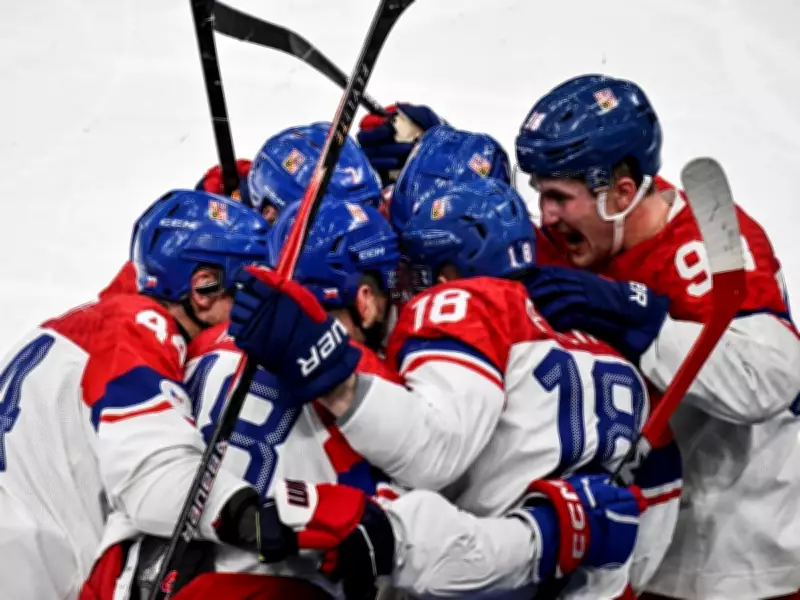
The Science Behind How Everyone Missed Czechia's Extra Skater vs. Canada
How did players, officials, and even fans completely miss the fact that Team Czechia had six skaters on the ice against Canada during a critical moment in the Olympic men's hockey quarterfinals? Turns out science has a clear explanation for this bizarre oversight, and it involves a well-known cognitive phenomenon.
The Gorilla Experiment Connection
Remember the famous video from about 15 years ago that showed people playing basketball while asking if viewers noticed a man dressed as a gorilla walking through the scene? This classic demonstration of selective attention provides crucial insight into what happened during Wednesday's game between Canada and Czechia at Milan Cortina 2026.
Researchers Christopher Chabris and Daniel Simons, who conducted the original gorilla experiment and later wrote the book 'The Invisible Gorilla,' have found that people focused on specific tasks can easily overlook unexpected but clearly visible events. This phenomenon, known as inattentional blindness, appears to explain exactly what occurred during the Olympic hockey match.

Players and Officials All Missed the Extra Skater
Remarkably, few if any of the Canadian players noticed the imbalance on the ice. Thomas Harley could only remark afterward that he was surprised he didn't have as much time to make a play as he anticipated. Nathan MacKinnon claimed he knew about the extra skater, but if true, he represented a tiny minority among those watching the game.
Even Connor McDavid, whose hockey intelligence operates at an elite level and who would typically be expected to catch such irregularities, admitted he completely missed the situation. "Not aware at all. I'm not sure how we missed it. Nobody even mentioned it until after the game," McDavid said. "We've got to do a better job paying attention. That being said, the refs do, too. Everybody can. I feel like everybody missed it."
Expert Analysis of the Cognitive Science
Daniel Memmert, a professor at the German Sport University in Cologne who researches inattentional blindness, confirmed the connection between the gorilla experiment and the hockey incident. As executive head of the Institute of Exercise Training and Sport Informatics, Memmert explained why this oversight occurred despite the extra skater being clearly visible.
"The comparison to the classic gorilla experiment is actually quite plausible from a cognitive science perspective," Memmert told Postmedia. "Situations like this often involve inattentional blindness, where officials and players are so focused on puck movement, positioning and game flow that an unexpected but visible event, such as an extra player, can go unnoticed in real time."
How the Brain Processes Information Under Pressure
Memmert elaborated on the neurological mechanisms behind this phenomenon, explaining that during fast-paced, complex games like hockey, the human brain cannot process everything simultaneously. Instead, it focuses attention on what seems most relevant—typically the puck and immediate play.
"This selective attention makes inattentional blindness likely, meaning clearly visible events outside the focus can be missed," Memmert explained. "Even experienced officials are vulnerable to this because it is a normal limitation of human perception under high pressure."
The brain's prioritization system becomes particularly relevant in high-stakes situations like Olympic competition, where split-second decisions and intense focus on specific elements of play can cause other important details to fall outside conscious awareness.
Even Spectators Experienced the Blindness
Sam Bennett, who was scratched from the game due to illness but watched from the stands, also failed to notice the extra skater despite watching the game intensely. "I didn't, actually. I'm surprised, because I was watching that game pretty intensely, but I missed that," Bennett said the following day.
This demonstrates that inattentional blindness affects not just participants directly involved in the action but also observers who might otherwise be expected to notice irregularities from a more detached perspective.

The incident serves as a fascinating real-world demonstration of cognitive science principles in action during elite athletic competition, showing how even the most attentive professionals can miss obvious details when their focus is directed elsewhere.