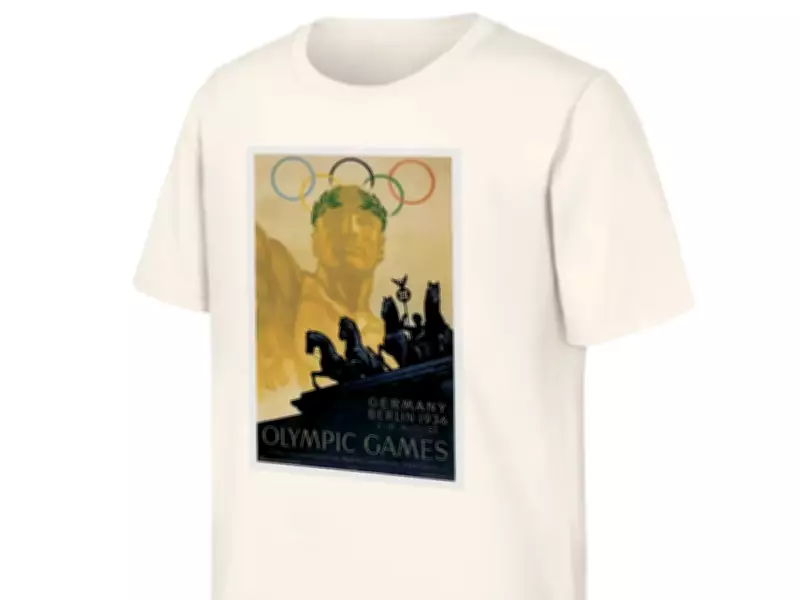
IOC Faces Intense Backlash Over 1936 'Nazi Games' T-Shirt Sales
The International Olympic Committee has ignited a firestorm of controversy with its decision to sell T-shirts commemorating the 1936 Berlin Olympics, widely known as the "Nazi Games." The limited-edition apparel featured the official poster from the Berlin Summer Games, which occurred three years into Adolf Hitler's rule and is largely viewed as an attempt to glorify the Third Reich on the global stage.
Intellectual Property Defense Sparks Further Outrage
Mark Adams, the IOC's official spokesperson, defended the organization's actions by stating the T-shirts were sold primarily to preserve intellectual property rights. "The validity of those trademarks depends on us exercising our rights," Adams explained to Reuters. "If we stop using the trademarks they can be taken by other people and potentially misused. We produce a small number of those items. The main reason is to protect our copyright so they are not misused."
The T-shirt design by Franz Würbel depicts a statuesque golden figure wearing a laurel wreath, towering over a chariot of horses positioned atop the Brandenburg Gates. The figure's raised arm extends out of frame toward the sky, creating a powerful visual that has drawn significant criticism given the historical context.

Jewish Organizations Condemn Commercialization of Painful History
Jewish groups and Holocaust remembrance organizations have strongly condemned the sale of these T-shirts, which have since sold out and been removed from the Olympic website. Christine Schmidt, co-director of the Wiener Holocaust Library in London, provided historical context to CNN: "The Nazis used the 1936 Olympics to showcase their oppressive regime to the world, aiming to smooth over international relations while at the same time preventing almost all German-Jewish athletes from competing, rounding up the 800 Roma who lived in Berlin, and concealing signs of virulent antisemitic violence and propaganda from the world's visitors."
Scott Saunders, CEO of International March of the Living, emphasized the normalization tactics employed by the Nazi regime during the Berlin Games: "As the world reflects on this latest controversy, it is impossible not to recall that we are approaching 90 years since the 1936 Berlin Olympics — an event the Nazi regime used to legitimize itself on the global stage while persecution of Jews was already well underway."
Historical Context and Selective Memory
In the lead-up to the Berlin Games, the Nazi regime temporarily removed antisemitic signage and eased anti-Jewish policies to present a more tolerant facade to international visitors, hoping to avoid potential boycotts. This calculated public relations effort contrasts sharply with the reality of systematic persecution occurring simultaneously.
Adams attempted to highlight positive aspects of the 1936 Games, specifically invoking African-American sprinter Jesse Owens, who won four gold medals and shattered Nazi myths of racial superiority. "We cannot rewrite history. The 1936 Games happened," Adams stated. "We hold up what Jesse Owens did, and a number of other athletes, as a great example of upholding the Olympic spirit."
The controversy raises complex questions about historical preservation, commercial exploitation, and the ethical responsibilities of international sporting organizations when dealing with painful chapters of history. As the debate continues, the IOC finds itself navigating the delicate balance between protecting intellectual property and respecting the traumatic legacy associated with the 1936 Berlin Olympics.