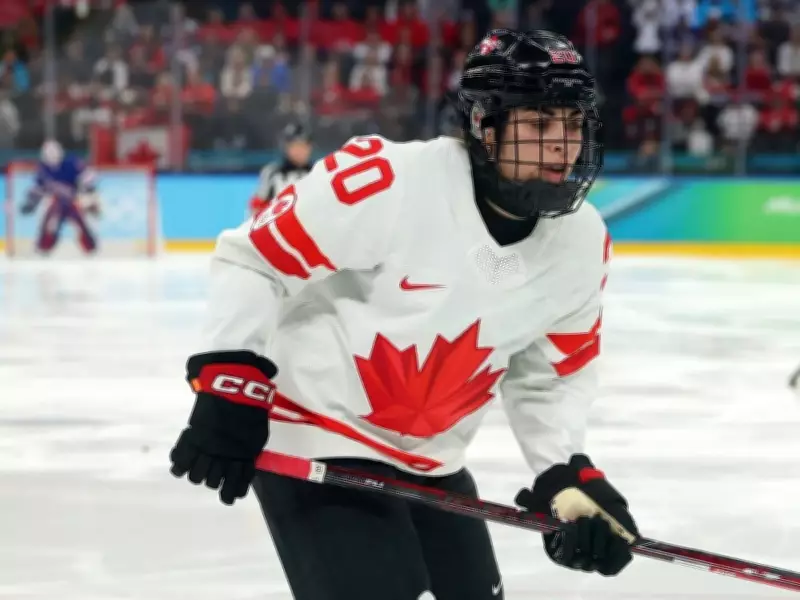
Sarah Nurse Champions Visibility for Black Women in Hockey
Even when her parents tried to shield her, the message still got through. "Growing up, there would always be people who would say, 'Black people don’t really play hockey, that’s not really your sport,'" said Sarah Nurse, who became the first Black woman to win Olympic gold in women’s hockey at the 2022 Beijing Games. "My parents sheltered me from a lot, but it was pretty isolating at certain points."
Worst of all was worrying about her hair. "I obviously don’t have silky, smooth, straight hair," she said. "I would get asked all the time if I could tame it." It might seem small, but to a teenage girl it’s a vulnerable point of differentiation. Nurse is still getting asked about her hair, only now those questions sound different. Six times this season, Nurse is hosting meet and greets at PWHL games she calls Nursey Nights, designed to welcome families who are new to hockey into the sport.
Breaking Barriers on the Ice
Not one Nursey Night goes by without the topic of hair coming up. "What do I do under my helmet? How many times do I wash it? How do I style it?" she said. She’s not gatekeeping any tips or tricks: She wants everyone to know she wears a headband to protect her edges. At the 2026 Olympic Games in Milan, Nurse played alongside Sophie Jaques, while Laila Edwards became the first Black woman to represent the United States in women’s Olympic hockey.

The presence of multiple Black women across both programs marks a significant shift from earlier Olympic cycles, when representation was often singular or nonexistent. For much of hockey’s history, this kind of visibility has been rare. "I didn’t grow up seeing myself in anybody in the hockey world," said Nurse. That’s what today’s generation of Black women hockey players are trying to change.
Historical Context and Legacy
When Angela James was making history for Canada at the inaugural IIHF women’s world championship in 1990, her impact barely registered beyond the small circle following the women’s game. James led the tournament in scoring, anchoring a Canadian team that helped define elite women’s hockey on the international stage. But this was still a pre-Olympic era—women’s hockey wouldn’t debut at the Games until 1998—and without a stable professional league, the sport existed largely outside the national spotlight.
Little attention was paid to the women’s side of the sport, and even less to the players shaping it. So much so that Nurse, who was born in 1995 at the height of James’ career—which included four world titles—didn’t hear about the women’s hockey legend until 2010, when James was inducted into the Hockey Hall of Fame. Nurse was 15 years old at that time and already chasing an Olympic dream of her own. "You didn’t hear about women’s hockey, let alone forgotten Black woman’s hockey history or somebody like Angela James," she said.
Women’s hockey in Canada has surfaced and receded in cycles, often shaped by wartime necessity, local patronage, or fleeting media interest. In 1915, the Eastern Ladies Hockey League emerged as the most competitive women’s league in the world, with teams based in Montreal, Ottawa and Cornwall. Games regularly drew capacity crowds of 3,200 and newspaper coverage treated its stars as legitimate sporting figures. By the late 1910s, women’s hockey had already begun to fade from public view again. Teams disbanded, leagues folded and coverage thinned.
While there are records of standout players—including Indigenous women such as Alida Gros-Louis (or Atsebatabon), who competed at a high level in Quebec—the broader history is fragmented, preserved unevenly in box scores, clippings and personal recollection. As for Black women, the record is even thinner. Charlie Lightfoot was the first Black man to play professional hockey, around 1900, before the colour barrier was broken in earnest in 1958 when Willie O’Ree signed with the Boston Bruins.

We know about the Coloured Hockey League in Nova Scotia, and there are surviving personal testimonies of early Black pioneers on the Prairies that indicate they participated in shinny on local rinks. But when it comes to women, the historical trail largely disappears. If Black women were lacing up skates, their participation went unrecorded, uncelebrated and unarchived. The thread becomes visible again decades later, with James, even if it took years for the sport to fully catch up. For the players coming up now, that silence has shaped how deliberately they approach visibility, access and mentorship.
Inspiring the Next Generation
That sense of firsts—and the weight that comes with them—is something Team USA’s Edwards is only beginning to process. In Milan, Edwards was the first Black woman to represent the United States in women’s Olympic hockey. "It’s surreal to even think about it being a possibility," she said. "It was in my wildest dreams." She remembers watching the 2010 Olympics as a child and imagining herself there. Now, the opportunity is real—and complicated. "There’s definitely a lot of mixed feelings," she said. "But as I’ve talked about it more, I’ve learned to embrace it."
Edwards said she’s conscious of what representation can mean for younger athletes who may be encountering the sport the same way she once did—without precedent. "I want to continue to inspire the next generation and other young people of colour to get out of their comfort zone and try to strive in a place that isn’t necessarily for you, and where many people don’t look like you." Nurse remembers giving advice to Edwards when she was just 10 years old and navigating the competitive hockey landscape with her sister Chayla. Nurse now occupies the space she never saw growing up: A visible, accessible point of reference for girls trying to decide whether they belong.
Building Confidence and Community
Confidence can be a challenge. "There are obviously the barriers that are spoken about so much—the financial barriers, access to sport, discrimination within the sport," said Nurse, who also hosts an annual Summer Summit to help girls prepare for business roles in sport. "But when I’m dealing with people face to face, the biggest thing I’m seeing is that confidence to take up space in the hockey world." Nurse isn’t the only athlete working to help other Black players.
Founded in 2020, the Women of Colour Hockey Collective was created to support BIPOC athletes. In addition to their mentorship initiatives the group administers $25,000 of scholarships annually to competitive athletes, in addition to grants for BIPOC athletes of all abilities to defray the costs of hockey. For Jaques, who serves on the collective’s board, the work is personal. "For my first few years, I was the only girl and the only Black player on my team," she said. "It was a bit tough."
While Jaques described supportive teammates, the isolation was still present—sharpened by watching her brother’s experience of overt racism in the sport. The extent of that isolation fully registered when she reached college. "It wasn’t until I got to college that I had another Black player on my team that I realized the magnitude of how few of us are in the sport," she said. Now, Jaques sees her visibility differently. "I’ve done a good job of embracing it now," she said. "Getting to see all the girls and getting to do it for them makes it more special and makes me want to be involved."
For Nurse, visibility on the ice is only part of the work. She’s already thinking about other rooms where she can continue to lead the story about Black women in hockey. Her next chapter could be another first for Black women: "I would love to be an owner in the PWHL one day," she said.