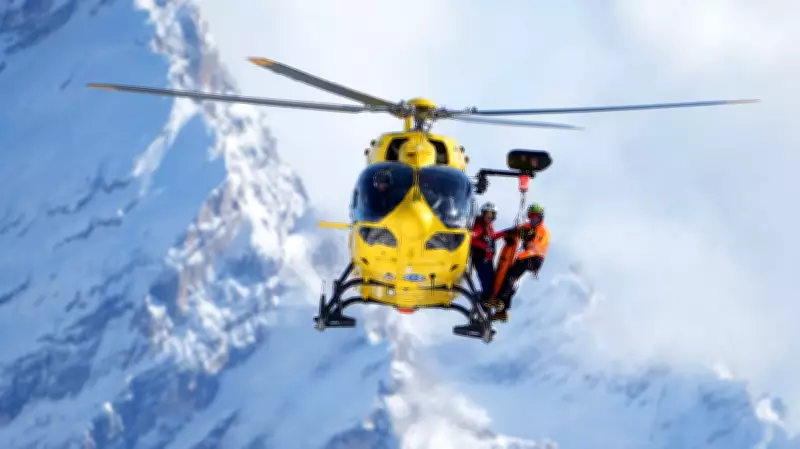
The whirling of helicopter rotors is arguably the most feared sound in the high-speed world of Alpine ski racing. It signifies a moment of grave concern, cutting through the crisp mountain air as a stark reminder of the sport's inherent dangers. Skiers, clad in little more than lightly padded body suits and helmets, hurtle down icy slopes at speeds reaching 80 mph (130 kph). A crash into safety nets or a violent tumble can lead to one of the most dramatic scenes in sports: an athlete being airlifted off the course, virtually mummified in a stretcher, dangling mid-air below a hovering helicopter before being whisked away over jagged peaks toward medical care.
Lindsey Vonn's Harrowing Experiences
American skiing legend Lindsey Vonn knows this sound all too well. During the Olympic downhill at Cortina d'Ampezzo, Italy, a frightening head-over-heels fall led to her second helicopter evacuation in just nine days. An earlier crash in a World Cup race in Switzerland had ruptured the ACL in her left knee; this second incident broke the same leg, necessitated immediate surgery, and potentially marked the end of her illustrious career. "The helicopters add an element of drama to it that is a bit heightened," noted Anouk Patty, the chief of sport for U.S. Ski and Snowboard, shortly after Vonn's latest evacuation. "But the reality is it's just the quickest way to get the athletes out to the clinic or the hospital where they need to go."
The Protocol and Personnel Behind the Rescues
Helicopter rescues in Alpine ski racing require meticulous coordination between local medical staff, team physicians, and highly skilled pilots. Before the Olympics, The Associated Press interviewed Nicola Cherubin, a rescue specialist who was lowered from the helicopter to retrieve Vonn. He confirmed directing the operation in Cortina, though privacy rules prevent discussing specific case details. International Ski and Snowboard Federation (FIS) regulations mandate that "a rescue helicopter or medically equivalent evacuation method must be available on a basis consistent with local law" at all World Cup, world championship, and Olympic downhill and super-G races.

A Two-Helicopter Minimum
While the rule does not explicitly state it, in practice, at least two helicopters are required. If one chopper is deployed to transport an injured athlete to a hospital, a backup must remain on standby to ensure continuous coverage. Approximately an hour before each race, helicopters fly into position, though adverse weather conditions like wind or fog can ground them, potentially leading to race cancellations or postponements.
Efficiency and Life-Saving Impact
Helicopter evacuations are often deemed more efficient than transporting injured athletes down steep, icy courses on sleds or toboggans, though sleds are still utilized in certain scenarios. "It saves lives," emphasized FIS president Johan Eliasch. The critical importance of swift response was underscored in September when Italian skier Matteo Franzoso died following a crash in preseason training in Chile. A delayed helicopter response on a course with limited safety fences prompted calls for enhanced safety protocols.
The Crew and Communication Codes
A typical helicopter crew comprises the pilot, emergency care physicians, and a rescue specialist like Cherubin. "I go down and handle the security on the ground," Cherubin explained. Communication is streamlined through coded signals: "01 or 2 means that just I go down and take the athlete up. Then if it's a Code 3, which means it's more serious, the doctor comes down, too." Injured athletes first receive treatment from a ground crew of medical personnel stationed at intervals along the course, in coordination with team physicians from the involved national teams.

Logistical and Medical Considerations
Once an athlete is secured to the rope, Cherubin radios the crew to initiate the ascent, typically keeping the stretcher outside the cabin during short flights. "When we have short flights of less than a minute, it doesn't make sense to get inside," he noted. "It's quicker just to stay outside and land that way." In Cortina, where the race finish is situated halfway up the mountain, injured athletes are flown down to a temporary medical station. From there, team medical personnel assist in deciding the next steps, which may involve transfer via a larger helicopter to a hospital trauma unit, ambulance transport to a local facility, or release.
Athlete Perspectives and Psychological Impact
Retired British downhiller Chemmy Alcott, now a BBC broadcaster, recounted her experience after suffering compound fractures in her right leg during a 2010 crash in Lake Louise, Alberta. "Fortunately by that point, I'd been given some morphine. So I was starting to lose my head a little bit — to stop the screaming," she recalled. "I only remember it because I've seen it in the video." Alcott described the intense mental focus during a fall: "You get this crazy slow motion focus. You think about your organs. You think, 'Right, how am I going to protect my neck, my back?'"
Medical Challenges and Athlete Reactions
Emergency care physicians in helicopter crews face unique challenges when treating athletes immediately post-injury. "They always want to get up right away. So we have to immobilize them and then re-examine them," said Lydia Rauch, an anesthesiologist with years of experience in crews at Val Gardena and Cortina races. "I've treated athletes with severely broken bones who told me that nothing was hurting them. And there could also be other internal injuries that you can't notice right away."
The Nerve-Wracking Wait for Competitors
The sound of helicopter blades can also profoundly affect the next skier awaiting their start, particularly during extended delays caused by a crash. Austrian racer Mirjam Puchner found herself in this position following Vonn's fall on Sunday. With the helicopter virtually at eye level, she noted, "All that time you're hearing that, it's playing on your nerves." Puchner, who finished 11th, has no memory of her own helicopter evacuation after breaking her right leg during downhill training at the 2017 world championships in St. Moritz, Switzerland. "I woke up in the hospital," she said.
Andrea Apollonio, in charge of medical services at the Cortina races, clarified a common misconception: "We often hear on TV that it's a very serious injury because the helicopter has come. But that's not always true. It's just an evacuation system." This system, while dramatic, remains a vital component of athlete safety in the perilous realm of Alpine ski racing, blending advanced logistics with immediate medical response to protect those who push the limits of speed and skill.