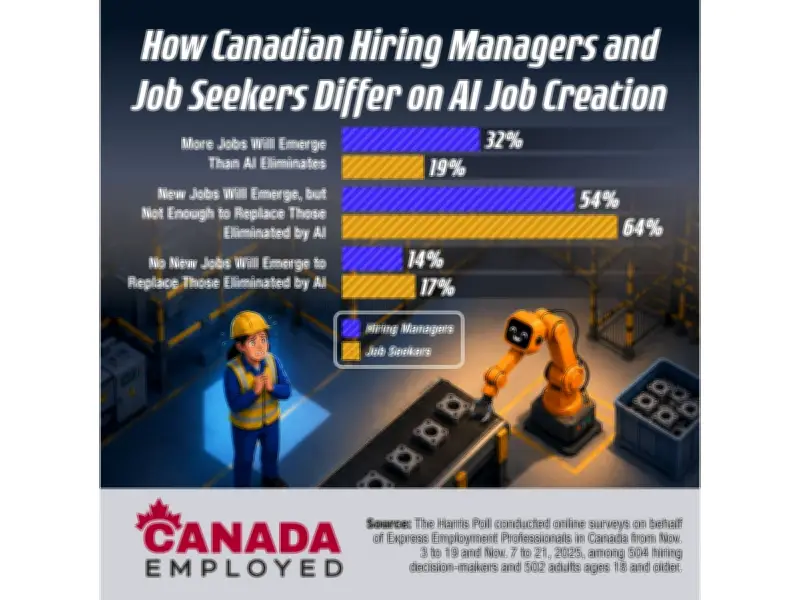
A new survey from Express Employment Professionals and The Harris Poll reveals that while artificial intelligence is helping businesses increase efficiency and address skills shortages, it is also intensifying concerns among workers about job security and future opportunities.
AI Adoption in Canadian Workplaces
The survey found that 63% of Canadian hiring managers report their companies use AI, while 53% of employed job seekers say the same about their own workplaces. These figures indicate that AI integration is already widespread across various industries.
Benefits of AI for Businesses
Hiring managers see clear advantages from AI adoption. Among them, 50% believe AI can help address the shortage of skilled talent, and 63% say integrating AI tools is essential to bridging the widening skills gap among new hires. Additionally, 67% expect generative AI to improve efficiency, 65% say it will free up employee time, and 52% believe it will enhance customer service.

The benefits are already manifesting in daily operations. Hiring managers report that AI has led to higher company productivity (24%), provided employees with more resources to improve skills (23%), boosted creativity (22%), and improved employee productivity (22%). Among companies using AI, 79% of hiring managers say the personal connection between employees and clients remains unaffected.
Growing Concerns Among Workers
Despite these positive outcomes, worker unease is rising. Nearly all job seekers (94%) express concerns about the growing use of AI in the workplace. Furthermore, 55% of hiring managers worry that AI-driven automation could diminish their company's brand personality.
Job seekers' primary concerns include an overdependence on technology (49%), reduced employee effort as AI takes over tasks (45%), fewer entry-level positions for gaining experience (40%), and a potential loss of creative thinking (49%) and problem-solving abilities (42%).
Two-thirds of hiring managers (66%) believe employees fear that generative AI will render them useless, highlighting a shift from productivity gains to anxiety about long-term value at work.
Impact on Workforce and Hiring
The tension becomes more concrete when considering workforce reductions. Half of hiring managers (49%) say AI could allow their company to reduce headcount by needing fewer workers, while 78% of job seekers are scared that companies will hire less due to AI.
This survey underscores the dual nature of AI in the workplace: while it drives efficiency and helps close skills gaps, it also fuels fears of job displacement and reduced opportunities, particularly for entry-level workers.