Artificial intelligence is fundamentally transforming how Canadian employees work together, creating both opportunities and concerns for businesses across the nation. According to a recent Express Employment Professionals-Harris Poll survey conducted in November 2025, while most companies view AI positively for improving collaboration, significant worries are emerging about its potential to replace human interaction and creative thinking.
The Positive Impact of AI on Workplace Collaboration
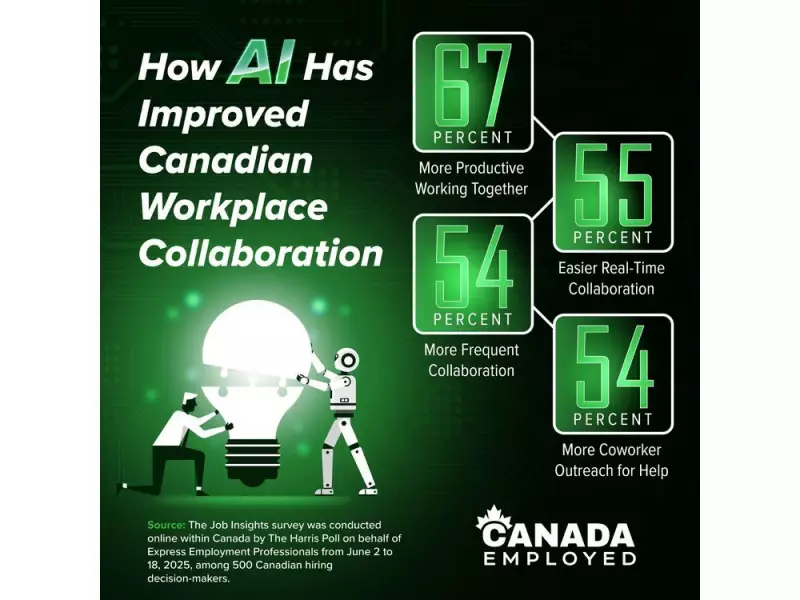
Canadian companies are reporting substantial benefits from implementing AI tools in their collaborative processes. The survey reveals that 67% of companies say AI has made employees more productive when working together, demonstrating clear efficiency gains. Additionally, 55% report improved real-time collaboration capabilities, while 54% note increased frequency of collaboration among team members.
Job seekers and employees working at companies that use AI tools echo these positive findings. Among this group, 56% say AI improves productivity in team settings, while 51% report easier real-time collaboration. Nearly half (47%) indicate they collaborate with colleagues more frequently, and 46% reach out to coworkers more often for assistance.

Real-World Applications Driving Collaboration
Practical AI implementations are demonstrating tangible benefits for Canadian workplaces. Modern tools now provide real-time meeting summaries, track action items automatically, and suggest relevant documents to team members. These features help keep teams aligned while significantly reducing email clutter that often hampers productivity.
Business leaders also highlight AI's ability to provide quick feedback on ideas without pulling coworkers away from their primary tasks. Another significant advantage comes from real-time translation capabilities that enable multilingual teams to work together more efficiently, breaking down communication barriers in diverse Canadian workplaces.
Growing Concerns About AI's Long-Term Impact
Despite these measurable benefits, Canadian employers are expressing substantial unease about AI's expanding role in the workplace. An overwhelming 89% of companies report concerns about how AI is changing workplace dynamics. More than half (55%) worry that AI could eventually replace the need for human collaboration entirely.
Additional concerns include diminished creativity, cited by 46% of employers, while 42% worry about declining problem-solving skills among employees. Another 40% fear reduced communication between team members as AI tools become more prevalent.
Job seekers share these apprehensions, with close to two-thirds (63%) fearing AI will eliminate the need to share ideas traditionally. A significant 44% believe teamwork could be fully replaced by AI within just five years, indicating rapid expected changes in workplace dynamics.
The Current Reality of AI Dependency
These concerns appear well-founded based on current workplace behaviors. The survey shows that three-quarters of companies using AI (76%) believe employees sometimes rely on AI instead of reaching out to coworkers for help or input. Notably, one quarter (25%) say this happens frequently.
Job seekers confirm this trend, with 65% admitting they engage in this behavior and 25% saying they do it frequently. This suggests a gradual shift toward AI-mediated work rather than direct human collaboration.
Bob Funk Jr., CEO, President and Chairman of Express Employment International, emphasizes that collaboration remains the foundation of successful teams. He notes that "AI can help by removing repetitive tasks and clearing roadblocks, but it should never replace the creativity and trust that come from people working together. The real opportunity is learning how to use these tools to strengthen, not sideline, human connection."
As Canadian workplaces continue to integrate AI technologies, the challenge remains balancing efficiency gains with preserving the human elements of teamwork, creativity, and interpersonal connection that drive innovation and company culture.