Canadian Companies Rapidly Adopting AI, But Most Employees Aren't Getting Trained To Use It
As artificial intelligence reshapes workplaces across Canada, a critical disconnect has emerged between technology adoption and workforce preparedness. According to a recent Express Employment Professionals-Harris Poll survey, while AI tools are becoming ubiquitous in Canadian businesses, the majority of employees report receiving these powerful technologies without adequate training to use them effectively.
The Training Gap Widens as AI Adoption Accelerates
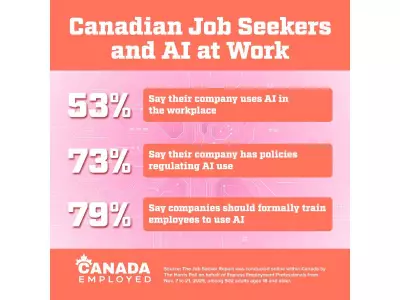
The survey reveals a striking consensus between job seekers and hiring managers about what's missing in Canada's AI revolution. More than three-quarters of Canadian job seekers (79%) believe companies need to provide formal AI training rather than expecting employees to learn independently. Hiring managers largely agree, with 77% stating that formal AI training should be a corporate priority.
This urgency reflects how quickly AI has transitioned from optional to essential in Canadian workplaces. Close to two-thirds of Canadian companies (63%) now use AI, with one in five companies (19%) reporting regular use. This represents a significant increase from just two years ago when only 52% of companies reported using AI, a figure that rose to 54% in spring 2025 and has continued climbing since.

"The adoption curve is dramatically outrunning readiness," notes the survey analysis. Among companies using AI, dependence on these tools is increasing rapidly, with 73% reporting their reliance on AI has significantly increased over the past year.
Uneven Adoption Patterns Across Industries
The survey identifies distinct patterns in how different sectors are embracing artificial intelligence:
- White-collar companies lead adoption with 68% reporting AI use
- Large employers with more than 100 employees show the highest adoption rate at 77%
- More than half of employed Canadian job seekers (53%) say their company uses AI at work
- 41% of employees report using AI themselves at least occasionally
Despite this widespread implementation, training has failed to keep pace with technological deployment. Employees are increasingly open to learning with AI, with two-thirds of job seekers (66%) saying it's appropriate to learn professional skills using artificial intelligence tools.
Policies Without Practical Guidance
The survey reveals a concerning pattern of regulation without practical support. A majority of hiring managers (58%) report their companies have policies regulating AI use, while an even higher proportion of employed job seekers (73%) say the same.
However, when it comes to actual implementation and tool guidance, direction remains inconsistent:
- Only 29% of companies provide a list of approved or preferred AI tools
- 37% allow employees to use any AI tools they're familiar with
- 18% report a mix of approved and open-use tools
"This lack of clarity leaves many employees navigating powerful technology largely on their own," the survey concludes, highlighting how policies without practical roadmaps create confusion rather than competence.
Optimism Persists Despite Training Deficiencies
Remarkably, despite the significant training gap, Canadian workers remain optimistic about AI's potential. Most job seekers believe AI can be part of the solution rather than the problem, with more than half (57%) saying their company's AI tools can help bridge skills gaps.
An even higher proportion (67%) indicate they are likely to seek additional training in response to AI advancements, suggesting a workforce eager to adapt if given proper resources and guidance.
The survey underscores a critical moment for Canadian businesses: as artificial intelligence becomes increasingly embedded in workplace operations, the gap between technology availability and employee proficiency represents both a significant challenge and a substantial opportunity for companies willing to invest in comprehensive AI training programs.