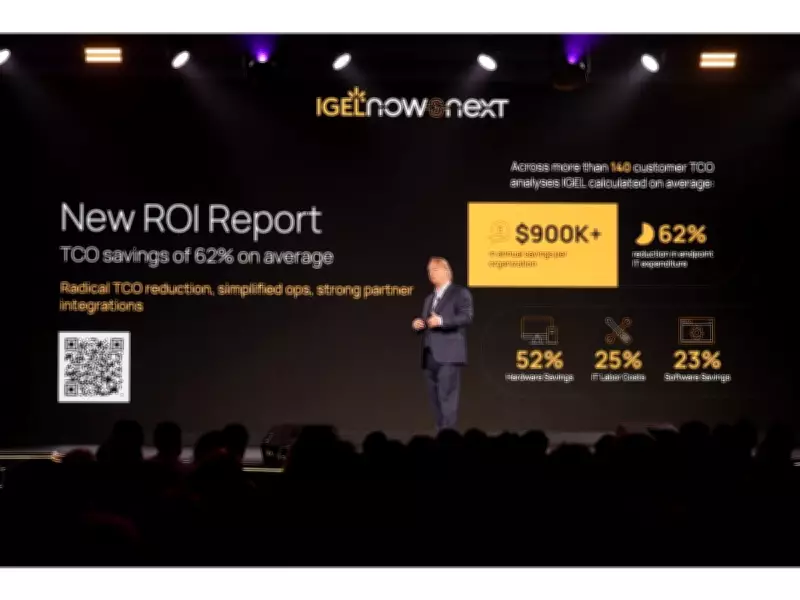
MIAMI, March 31, 2026 - IGEL, a global software company specializing in Adaptive Secure Endpoint Platform solutions for modern digital workspaces, has unveiled groundbreaking research findings that quantify significant cost savings in enterprise IT operations. The comprehensive study, titled "Unlocking Endpoint ROI with IGEL," reveals that organizations can achieve an average 62 percent reduction in endpoint IT expenditure through adoption of prevention-first security architecture.
Substantial Financial Impact Across Industries
The research analyzed more than 140 enterprise environments spanning multiple sectors, including financial services, healthcare, manufacturing, and government agencies. The findings demonstrate that companies implementing IGEL's immutable, prevention-first approach can realize substantial financial benefits while simultaneously strengthening their Zero Trust security posture.
Quantifiable Savings Breakdown
According to the study, organizations can save more than $900,000 annually through optimized endpoint management. The cost reductions break down into specific categories:

- 52 percent reduction in hardware expenses
- 25 percent decrease in IT labor costs
- 23 percent savings on software expenditures
Industry-Specific Results
The research highlights significant financial impacts across different sectors. Financial services organizations are achieving average annual savings of $3.5 million while meeting increasingly stringent Zero Trust requirements. Healthcare providers are redirecting approximately $800,000 annually toward patient care and enhanced cybersecurity investments.
Manufacturing enterprises are realizing $1.3 million in savings that can be reinvested in Industry 4.0 modernization initiatives. Government agencies are reducing endpoint IT spending by 63 percent while advancing both compliance objectives and security goals.
Leadership Perspectives on Security Economics
Klaus Oestermann, CEO of IGEL, emphasized the strategic importance of these findings. "Security has reached a critical inflection point where traditional approaches are no longer effective from either cost or security perspectives," Oestermann stated. "This research demonstrates that organizations adopting our Preventative Security Model are fundamentally rewriting the economics of endpoint strategy. What was once considered a tradeoff between cost reduction and security enhancement has become a multiplier effect."
Changing Security Priorities
The research arrives at a time when endpoint security remains a significant budget priority for organizations worldwide. According to PwC's 2026 Global Digital Trust Insights, 15 percent of security leaders rank endpoint security among their top three cybersecurity budget priorities. In this context, reducing the cost and complexity of endpoint operations enables organizations to pursue stronger security outcomes more efficiently.
Expert Analysis on Prevention-First Architecture
James Millington, Vice President of Product and Solutions Marketing at IGEL and principal author of the study, explained the broader implications. "Enterprises across every sector are recognizing that conventional approaches to endpoint security no longer meet the demands of a Zero Trust environment," Millington noted. "Leaders in financial services, healthcare, and manufacturing are increasingly turning to prevention-first architectures because the benefits are tangible and measurable: enhanced security, reduced costs, and improved organizational resilience."
Strategic Implications for Enterprise Technology
The IGEL research confirms that organizations can eliminate local attack surfaces while simplifying endpoint management through prevention-first security architecture. This approach not only reduces IT expenditure but also creates opportunities for strategic reinvestment in digital transformation initiatives.

As enterprises continue to navigate complex cybersecurity landscapes while managing operational costs, the study provides compelling evidence that smarter endpoint security choices can deliver both immediate financial benefits and long-term strategic advantages. The findings suggest that prevention-first architectures represent a viable path toward achieving stronger security outcomes while optimizing IT budgets across diverse industry sectors.