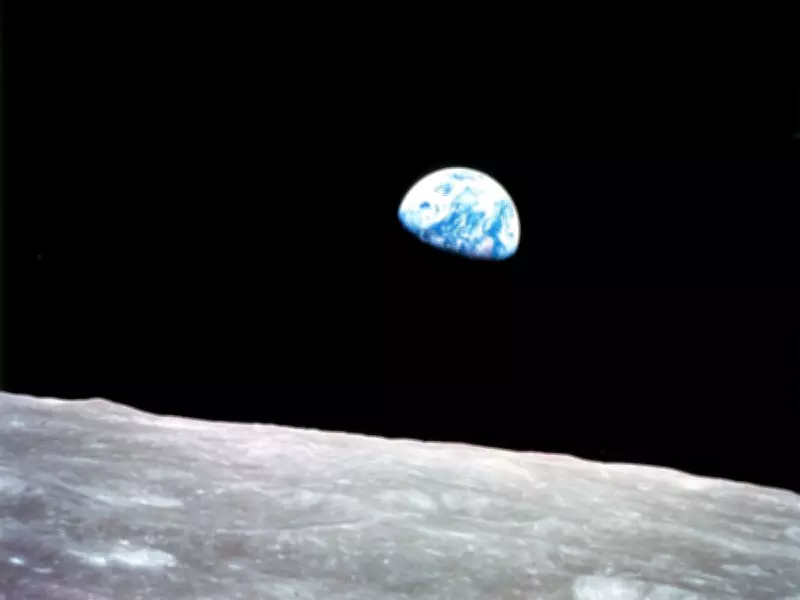
Artemis Mission Echoes Earthrise: A Humbling Cosmic Perspective for Humanity
The recent lunar orbit of the Artemis II mission has powerfully reminded humanity of the iconic "Earthrise" photograph captured during the Apollo 8 mission in December 1968. For the first time in history, human beings saw our planet as a complete, beautiful blue marble suspended against the ethereal, vast blackness of space. Throughout all of human existence, people had looked up at the moon, but never before had they looked down upon the Earth from such a profound distance.
The Enduring Impact of a Single Photograph
While Apollo 8 was followed just seven months later by the historic Apollo 11 moon landing in July 1969, many argue that the Earthrise photograph actually had a greater cultural and psychological impact than the first moon walk itself. The image provided a visual representation of what had previously been only an ingrained intuition: that our world is a singular, shared entity. Despite perennial rivalries between peoples, tribes, and nations, the photograph revealed that we all share common passage upon this small, lonely cosmic vessel traveling through the universe.
The photograph's influence extended far beyond space exploration. For travelers in the 1980s and 1990s, the popular "Lonely Planet" guidebook series became essential reading for pre-internet trip planning. Founded in 1973, the series title resonated deeply with a generation that had seen the Earthrise image—a visual representation of our isolated planet in the cosmos. The connection between the photograph and this cultural phenomenon raises intriguing questions about how visual representations shape our collective consciousness.

Galvanizing Environmental Consciousness
The suspended blue sphere had perhaps its greatest impact not on recreational travel, but on the emerging ecological movement. A new planetary consciousness emerged from that single image—not merely that individual mountains, canyons, rivers, or lakes were precious, but that the entire planet was beautiful, fragile, and worthy of careful stewardship. The photograph inspired a fundamental shift in perspective: if Earth appeared so beautiful from a distance, shouldn't its beauty be preserved and cared for up close? This created a new environmental ethos: see cosmically, care locally.
While scientifically the Earth is remarkably resilient—having survived cataclysmic events over billions of years and demonstrating remarkable regenerative capacity in mere decades—the visual representation of our small blue sphere against immense emptiness made our planet appear tiny, vulnerable, and fragile. This perception created a powerful sense of responsibility among the only beings capable of seeing Earth from this perspective: humanity itself now had a special duty of care toward our shared home.
Ancient Wisdom Meets Modern Imagery
The ecological movement found powerful inspiration in December 1968, but the fundamental injunction to care for creation has much deeper roots in human history and wisdom traditions. During their Christmas Eve 1968 broadcast from lunar orbit—heard by approximately one-fourth of humanity—the Apollo 8 astronauts chose to read from the first ten verses of Genesis: "In the beginning, God created the heavens and the earth."
Interestingly, they did not read from Genesis 2:15, which describes how the Lord God placed humanity "in the garden to till and keep it." This passage forms the biblical foundation for the concept of stewardship—the idea that humans are called to care for creation, to make it fruitful, to cultivate its resources responsibly without destroying them. Economists sometimes speak of creation as a "common good," vulnerable to the "tragedy of the commons" where shared resources are exploited without adequate preservation.
Ancient moral wisdom teaches that what is held in common represents an invitation to share, collaborate, cooperate, and care. The Earthrise photograph provided the powerful visual complement to these timeless words. As every educator and editor understands, a compelling image can convey meaning equivalent to thousands of words—even when those words come from sacred scripture. The Artemis mission continues this legacy, offering humanity renewed opportunities for cosmic perspective and humble reflection on our place in the universe.