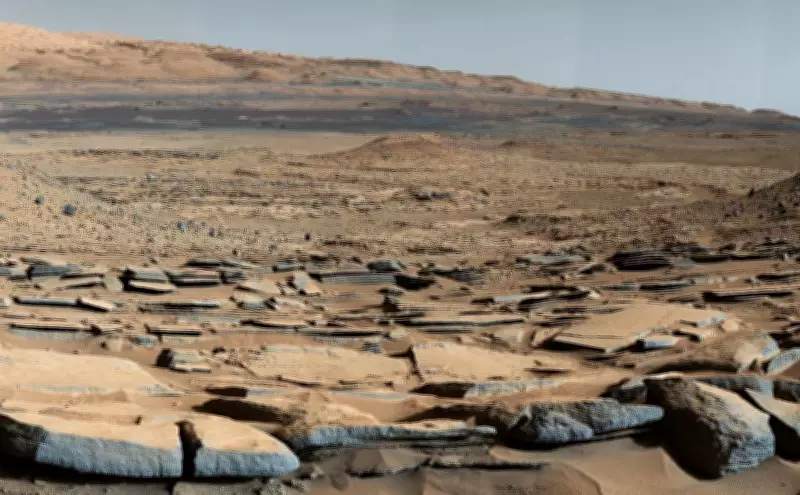
Geological 'Bathtub Ring' on Mars Offers Fresh Proof of Ancient Ocean
New findings from NASA's Curiosity rover have uncovered what scientists are describing as a "bathtub ring" on the Martian surface, providing some of the strongest evidence yet that a vast ocean once covered approximately one-third of the red planet. This discovery, announced in April 2026, adds significant weight to the long-debated theory that Mars harbored substantial bodies of water in its distant past.
Curiosity's Pivotal Discovery at the Kimberley Formation
The critical evidence comes from the "Kimberley" formation, a site extensively studied by the Curiosity rover. Researchers analyzing the geological data have identified distinct sedimentary layers and mineral deposits that closely resemble the residue left behind by receding water on Earth. This pattern, analogous to the ring left in a bathtub after draining, suggests a stable shoreline that persisted over an extended period.
The scale implied by this formation is immense. If the interpretations are correct, this ancient Martian ocean would have been a dominant feature, fundamentally altering our understanding of the planet's climatic history and its potential to support life. The ocean is believed to have existed billions of years ago, during a period when Mars was a much warmer and wetter world.

Implications for Martian History and Astrobiology
This discovery is more than just a geological curiosity; it has profound implications. The presence of a long-standing, large ocean significantly increases the probability that Mars once had conditions suitable for life. Stable bodies of water are considered one of the key prerequisites for the development of life as we know it.
Scientists are now re-evaluating models of the Martian climate and hydrological cycle. The evidence suggests that water did not just exist in fleeting forms like ice or short-lived floods, but as a persistent, planet-shaping force. This reshapes the narrative of Mars from a perpetually dry world to one that underwent a dramatic climatic shift, losing its oceans over eons.
Ongoing Research and Future Missions
The data from Curiosity is being cross-referenced with observations from orbiters and other rovers to build a more complete picture. Key questions remain:
- How long did this ocean persist?
- What was its chemical composition?
- What caused the water to ultimately disappear?
Future missions, potentially including sample return projects, will aim to drill into these sedimentary layers to analyze their chemistry directly. Understanding the history of water on Mars is not only about the past; it is also crucial for planning future human exploration and assessing the planet's resources.
This "bathtub ring" serves as a silent testament to a vanished Martian sea, offering a tangible clue in the ongoing quest to unravel the mysteries of our planetary neighbor and its capacity to have once harbored life.