Astronomers have uncovered a fascinating and long-term cosmic relationship between Earth and its moon, revealing that our lunar neighbor has been consuming molecules from our planet's atmosphere for billions of years.
A Billions-Year-Old Delivery System
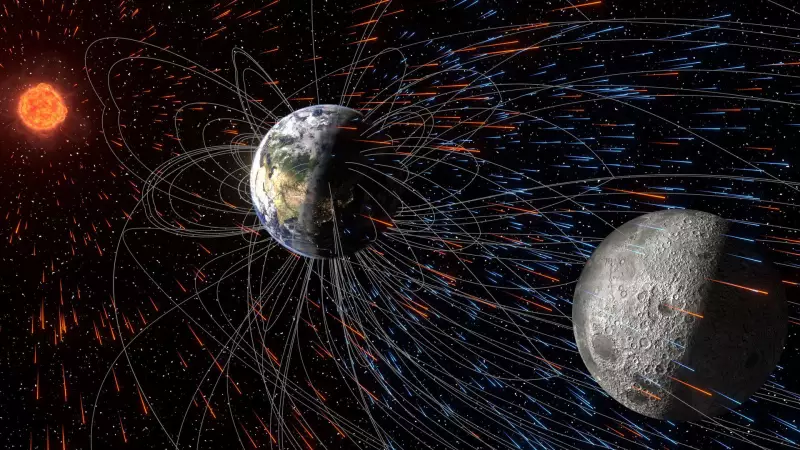
The process is driven by a powerful combination of forces. Solar wind, in tandem with Earth's magnetic field, acts as a delivery mechanism, sweeping particles from the upper layers of our atmosphere and depositing them onto the barren surface of the moon. This transfer of material is not a new phenomenon but a persistent interaction that has shaped the chemical makeup of the lunar regolith over eons.
Researchers illustrate that this isn't a sudden event but a continuous, slow process integral to the Earth-Moon system's dynamics. The finding, reported on January 13, 2026, provides a new layer of understanding about how celestial bodies in close proximity can exchange matter and influence each other's environments.

Implications for Lunar Science and Beyond
This discovery has significant implications for lunar science. It suggests that the moon's surface may hold a historical record of Earth's ancient atmosphere, trapped within its soil and rocks. By studying these captured particles, scientists could potentially unlock clues about the composition and evolution of our planet's air throughout geological time, offering insights that are no longer available on Earth itself due to tectonic activity and erosion.
Furthermore, understanding this particle flow is crucial for future lunar exploration and potential resource utilization. It adds a new dimension to what constitutes "local" material on the moon and may influence how scientists interpret data from lunar orbiters and landers.
Confirming a Cosmic Connection
The research solidifies the moon not just as a passive celestial companion, but as an active participant in a shared system with Earth. While the moon lacks a substantial atmosphere of its own, it has been subtly collecting traces of ours for its entire history. This work moves beyond theoretical models, providing a concrete mechanism for how planetary material can travel through space and be captured by another world.
As space agencies like NASA and the Canadian Space Agency plan renewed missions to the moon, findings like these will be vital. They underscore the deep interconnection between our planet and its satellite and highlight the moon's role as a unique archive of not just lunar, but also terrestrial, history.