NASA's Artemis II Mission Captures Historic 'Earthset' Image
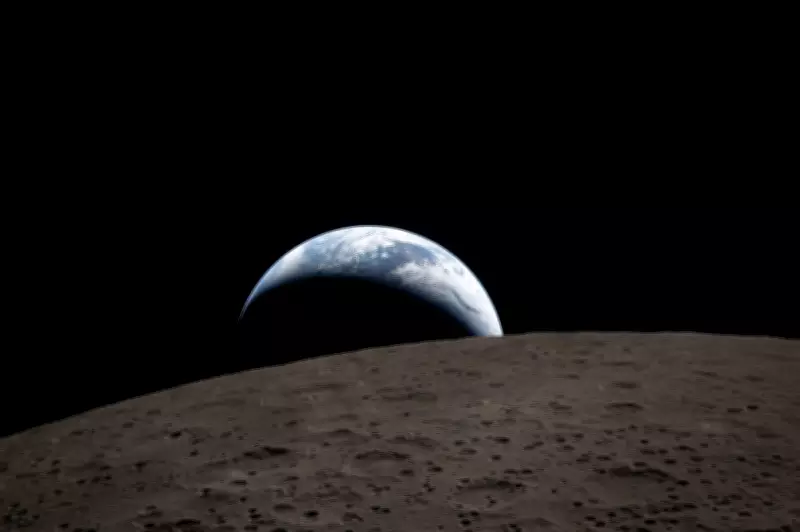
NASA has unveiled a breathtaking photograph of Earth descending below the lunar horizon, captured by the Artemis II mission crew. This remarkable image emerges almost six decades after the legendary "Earthrise" photo was taken by Apollo 8 astronaut Bill Anders in 1968, marking a poignant moment in space exploration history.
Artemis II Crew's Record-Breaking Journey
The "Earthset" shot was taken from the Orion spacecraft during the Artemis II mission's unprecedented lunar flyby. The crew, consisting of Canadian astronaut Jeremy Hansen and American astronauts Victor Glover, Christina Koch, and Reid Wiseman, embarked on this historic voyage to orbit the moon, paving the way for a planned lunar landing in 2028. On Monday, April 6, 2026, they achieved a new milestone by traveling farther into deep space than any humans before, setting a record for distance from Earth.
Jeremy Hansen, hailing from southwestern Ontario, becomes the first Canadian to journey to the moon, with Canada now recognized as only the second nation to send an astronaut this far into space. Reflecting on the achievement, Hansen emphasized that this moment should "challenge this generation and the next to ensure this record is not long-lived," inspiring future advancements in space exploration.

Unprecedented Lunar Observations
During their mission, the Artemis II astronauts have documented unique lunar surface features with unprecedented detail. They also witnessed a rare solar eclipse, where the moon passed in front of the sun, an event described by the White House as "a view few in human history have ever witnessed." Both NASA and the White House shared these images on social media, with the White House posting on X: "Humanity, from the other side. First photo from the far side of the Moon. Captured from Orion as Earth dips beyond the lunar horizon."
The Voyage Home and Safety Measures
The crew is now en route back to Earth, following a free-return lunar trajectory designed by Mission Control to ensure a swift and safe return. They are expected to splash down in the Pacific Ocean off the coast of San Diego, California, on Friday. Canadian astronaut Chris Hadfield provided context on X, noting that the crew is "falling 400,000 km to Earth, picking up speed pretty much the whole way." He highlighted the risks, mentioning a "miniscule chance" of hitting orbital debris, but emphasized that the real challenge will be atmospheric re-entry, where they will decelerate from 40,000 km/h to parachute speed, relying on the heat shield for protection.
This mission not only celebrates a new chapter in space exploration but also honors the legacy of past achievements, bridging decades of human curiosity and technological progress.