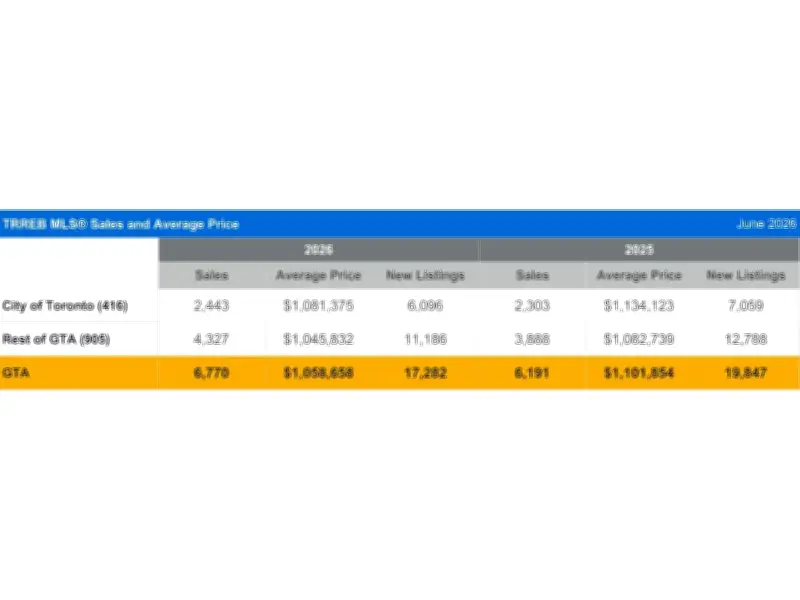
Greater Toronto Area housing market conditions continued to improve in June 2026, with sales growing strongly year-over-year while new listings declined. For the first half of 2026, sales edged higher compared to the same period in 2025, with new listings down substantially.
Sales and Listings Data
GTA REALTORS reported 6,770 home sales through TRREB’s MLS System in June 2026, an increase of 9.4 per cent compared to June 2025. New listings entered into the system amounted to 17,282, down by 12.9 per cent year-over-year. On a seasonally adjusted basis, June sales were up month-over-month compared to May 2026, while new listings were down, suggesting that market conditions have tightened through the spring.
Price Trends
The MLS Home Price Index Composite benchmark was down by 5.4 per cent year-over-year in June 2026. The average selling price, at $1,058,658, was down by 3.9 per cent compared to June 2025. However, on a month-over-month seasonally adjusted basis, both the average selling price and the HPI Composite were up slightly compared to May 2026.

Market Outlook
“After a slow start in the first quarter, we saw a marked improvement in home sales in the second quarter of this year. This result followed TRREB’s 2026 outlook, which called for a year of two halves. We expect accelerating transactions and more competition between buyers in the last six months of the year, helping to satisfy pent-up demand and ultimately resulting in renewed price growth,” said TRREB President Daniel Steinfeld.
Affordability Concerns
“While the average selling price was still down year-over-year in June, the annual rate of decline has receded over the past few months. If market conditions continue to tighten in the second half of 2026, selling prices could move in line with 2025 and eventually post some increases. This would give an increasing number of households the confidence to move back into the marketplace,” said TRREB’s Chief Information Officer Jason Mercer.
“Housing affordability remains a priority for the region. Development charges, while essential to funding local infrastructure, have substantially increased the upfront cost of housing delivery. This, in turn, contributes to higher purchase prices and rental costs as they can amount to up to 20 per cent of a home’s purchase price. The Canada-Ontario DC Reduction Program presents a meaningful opportunity for municipalities to reduce these charges while accessing provincial funding to offset related fiscal impacts,” said TRREB CEO John DiMichele.