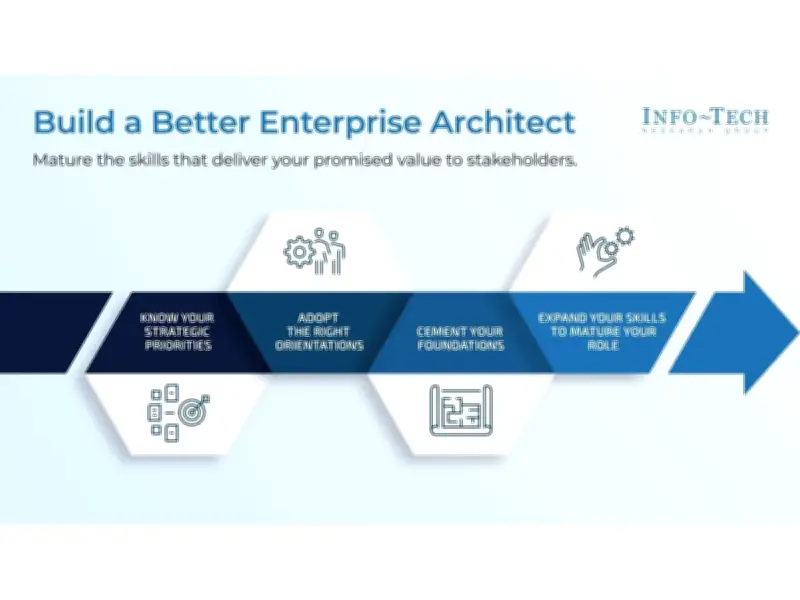
Info-Tech Research Group has released a new blueprint, Build a Better Enterprise Architect, to help CIOs and EA leaders define the enterprise architect role with clarity, prioritize essential skills, and map development milestones to stakeholder value. The firm's research indicates that vague role definitions and generic skill expectations erode credibility, stall momentum, and weaken business alignment.
Blueprint Addresses Role Ambiguity and ROI Pressure
Despite continued investment in enterprise architecture (EA) practices, many organizations struggle to demonstrate measurable results. Budget pressures have increased scrutiny on ROI, yet EA functions often lack a role anchored to specific outcomes. Info-Tech's blueprint helps organizations translate broad expectations into focused development plans that build credibility and strengthen business alignment.
Andrew Kum-Seun, research director at Info-Tech Research Group, stated, "Enterprise architects often become difficult to justify and resource because many organizations expect architects to do too much at once. Info-Tech's framework helps leaders focus the role around the outcomes that matter most."

Key Challenges Identified in EA Role Development
Info-Tech's research highlights several systemic barriers that organizations consistently encounter:
- Role ambiguity undermines credibility. Without a context-specific definition of the enterprise architect's purpose, scope, and reporting structure, architects take on misaligned expectations and struggle to build organizational trust.
- Generic skillsets create false confidence. Industry frameworks and job descriptions may not capture what an organization needs from its enterprise architects. Evaluating every possible skill at once produces unfocused development plans that fail to deliver results.
- Orientation mismatches limit delivery. Enterprise architects can embody several distinct orientations. Choosing the wrong orientation constrains the value the role can deliver.
- Stakeholder buy-in falters without measurable objectives. If progress takes too long to materialize, early enthusiasm fades, and the role loses organizational support before it matures.
Blueprint Provides Structured Path to Value
Info-Tech's blueprint moves beyond generic job descriptions, emphasizing that effective enterprise architects also need strong analytical thinking, relationship-building, communication, and storytelling skills to influence decisions and deliver value. The framework offers a structured path to help organizations create an enterprise architect role aligned to stakeholder outcomes.
By using the blueprint, CIOs and EA leaders can prioritize the skills that matter most and map development milestones to real stakeholder value, ensuring that EA initiatives demonstrate impact before losing momentum.