After Hannibal and his army marched across the Alps and crushed the Roman army at Cannae in 216 BC, reporters asked the Carthaginian leader what explained his victory. “Well,” he replied, “The elephants helped. They helped a lot. And so did the courage of my soldiers. But, to my mind, the key difference was the quality of our banking services.”
George S. Patton, a driving force in the Allied charge across Europe after the D-Day invasion, reflected toward the end of his life: “Yes, it’s very gratifying to be regarded as one of history’s greatest tank commanders. But what I always really wanted to be was a bank commander.”
Russia’s Vladimir Putin reportedly is spending more and more of his time in isolation and even underground. Most reports attribute this to his fear of a decapitation attack by Ukrainian drones but sources inside the Kremlin confirm that what really has Putin rattled is news of NATO’s new Defence, Security and Resilience Bank, which is to be located in Canada.

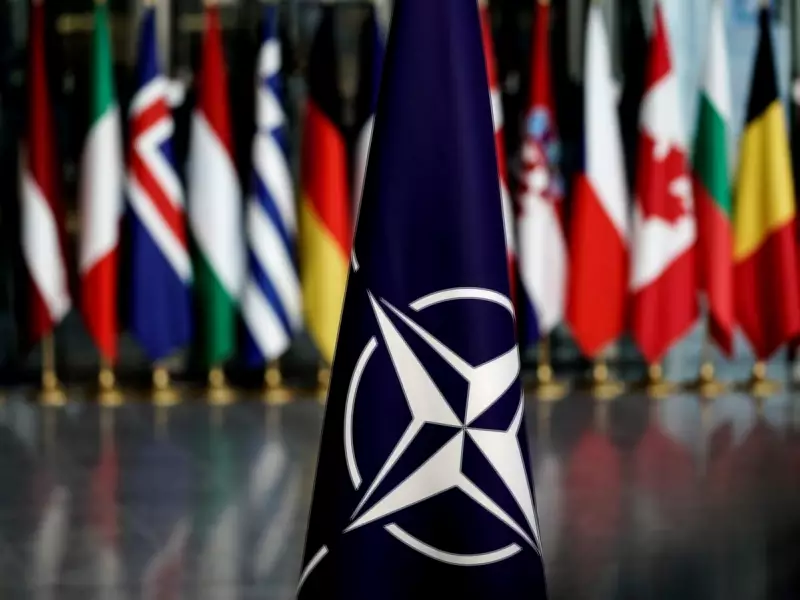
Yes, in response to Donald Trump’s urging it to pick up more of the common defence burden, NATO is setting up … a bank. And for some reason it has decided to locate it in Canada. Perhaps to put it as far away from Putin as possible, so that if he does invade more of Europe, at least NATO’s money will be safe (as most of Britain’s gold was held safely in the Bank of Canada and Montreal’s Sun Life Building after being shipped across the Atlantic in 1939-40).
If safety is a concern, does NATO not know that the frigid vastness of our North is almost entirely undefended? You can’t actually see Russia from our Arctic islands, as you can from Alaska, but you know it’s looming there, just across the increasingly traversable Arctic Ocean (America’s Ocean, as Donald Trump no doubt thinks of it).
What’s the real reason NATO chose us? Did we offer the biggest subsidies (i.e., kickbacks)? Did the organization want to encourage one of its recently least enthusiastic contributors? Or maybe it has heard that Canada’s new government is turning basically everything into a bank, so who better to run a new bank than what Napoleon might have called a “nation of bank clerks?”
Whatever the reason, we have been chosen. So now the hard part begins: deciding where to put the new bank. Five cities are bidding: Ottawa-Gatineau, Montreal, Toronto, Halifax and Vancouver. Vancouver is clearly an extreme safety play: if you calculated NATO’s geographic centre, Vancouver must be the farthest away from it of any city in the 32 member countries. Premier David Eby is making the best of his remoteness by playing up how Vancouver is midway between Canada’s Atlantic and Pacific allies. Antarctica could say the same.
You just know Ottawa would prefer to dispense with the political burden of choice and impose the traditional Canadian compromise by giving a piece of the new bank to each of the five bidders. But NATO, familiar down to its DNA with politically-driven inefficiency, presumably will not allow that. So choose Ottawa must.
Perhaps the ferocity of our infighting is reassuring to NATO, which is after all mainly a military alliance. The vicious interprovincial infighting over where to put the new financial institution reveals the darkest parts of the Canadian character. Yet, it also showcases our passion and commitment to being part of this historic endeavour. As the bidding wars intensify, one can only hope that the final decision strengthens both Canada's role in NATO and the alliance's financial resilience against any threat, real or imagined.