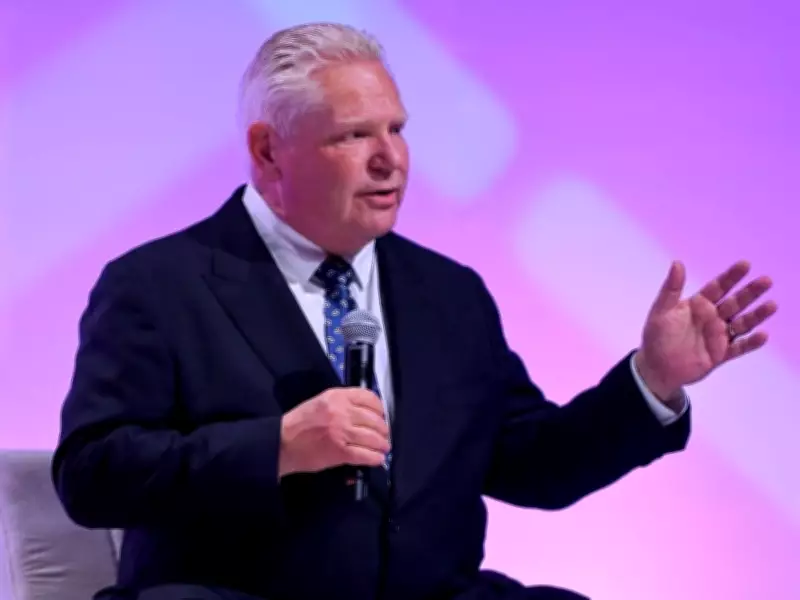
Ontario Premier Doug Ford has issued a direct appeal to Irving Oil's refinery located in New Brunswick, urging an immediate halt to the importation of foreign oil. This call to action was made during a panel discussion at the Canadian Chamber of Commerce's future business summit held in Ottawa this week, where Ford emphasized the critical need for Canada to bolster its domestic energy infrastructure.
Advocating for Canadian Sovereignty in Energy
Ford expressed strong concerns regarding Canadian sovereignty, stating that the oil currently being imported comes from "some people that don't like us." He highlighted the geopolitical risks associated with relying on foreign sources, particularly in light of global tensions. The premier's remarks underscore a growing push within Canadian political circles to reduce dependency on international oil markets and strengthen national energy security.
Building East-West Energy Corridors
During the summit, Ford stressed the necessity of enhanced cooperation among provinces to develop major infrastructure projects, specifically pipelines that traverse the country from east to west. "It's absolutely critical we build that pipeline east-west corridor," Ford asserted. He pointed out that Canada, as the world's fourth-largest oil producer with substantial reserves, should not be importing hundreds of millions of barrels from abroad when domestic resources are available.

Ford described the construction of such pipelines as a "no-brainer," questioning why oil from Alberta and Saskatchewan cannot be transported to refineries like Irving's in New Brunswick or to Sarnia in Ontario, where Imperial Oil has additional capacity. This move, he argued, would mitigate threats from external pressures, such as those posed by the United States regarding Line 5.
Addressing Line 5 and American Regulations
Line 5, operated by Enbridge, is a pipeline that carries over half a million barrels of oil and natural gas daily from western Canada to Ontario, passing through U.S. territory, primarily Michigan. Michigan Governor Gretchen Whitmer has long sought to shut down this pipeline due to safety concerns, although no leaks have been reported to date. Ford referenced this ongoing dispute, suggesting that expanding Canadian pipelines could reduce vulnerability to such foreign regulatory challenges.
Provincial Initiatives and Studies
In response to these concerns, Ontario announced last year that it is advancing a multi-province study into a new pipeline route from Alberta and Saskatchewan to James Bay. This initiative aims to circumvent American regulation by keeping the infrastructure within Canadian borders. Similarly, Manitoba has proposed a pipeline to its Port of Churchill to facilitate the transport of western oil to eastern markets.
Canada's Reliance on Foreign Oil
Despite its vast oil production and reserves, Canada imports approximately half a million barrels of crude oil daily from other countries. More than half of these imports are directed to the Irving refinery in Saint John, New Brunswick. In 2024, the primary sources of foreign oil for Canada were the United States, Nigeria, and Saudi Arabia. However, recent geopolitical events, such as the war on Iran and the blockade of the Strait of Hormuz, have disrupted supplies, leading Irving to turn to Newfoundland for crude.
Political and Economic Implications
Prime Minister Mark Carney has also highlighted the importance of developing Canadian oil resources for geopolitical and sovereignty reasons. He mentioned "conventional energy" opportunities in Atlantic Canada and the Far North, noting that some projects may be defense-related. Carney referenced investments in the Port of Churchill and hydro power spending in Nunavut and the Northwest Territories as part of this broader strategy.
Ford's advocacy aligns with these national efforts, emphasizing that building robust energy infrastructure is essential for Canada's economic independence and security. As debates over energy policy continue, the push for a self-reliant Canadian energy sector gains momentum, with implications for trade, environment, and international relations.