Middle East Conflict Escalates, Triggering Global Energy Crisis
Fears of a worldwide energy crisis intensified on Monday as the war in the Middle East continued to rage, marked by additional U.S.-Israeli strikes on Tehran and Israel's bombardment of Lebanon. A significant development occurred when an Iranian drone strike temporarily shut down Dubai International Airport, a critical global travel hub, highlighting the severe threats posed to the international economy.
Iranian Attacks Disrupt Critical Infrastructure
Since the United States and Israel initiated attacks on Iran more than two weeks ago, Tehran has consistently targeted Israel, American military bases in the region, and the energy infrastructure of Gulf Arab nations using drones and missiles. In a particularly impactful move, Iran has effectively halted shipping traffic through the Strait of Hormuz, a vital maritime passage responsible for transporting approximately one-fifth of the world's oil supply. This disruption has dramatically driven up oil prices, placing immense pressure on Washington to implement measures that alleviate the financial strain on consumers.
Brent crude, the international benchmark for oil prices, remained stubbornly above $100 per barrel on Monday. It reached $104 in early trading, representing a staggering increase of nearly 45% since the U.S. and Israel attacked Iran on February 28. During the ongoing conflict, prices have spiked as high as approximately $120.
Dubai Airport Attack and Regional Strikes
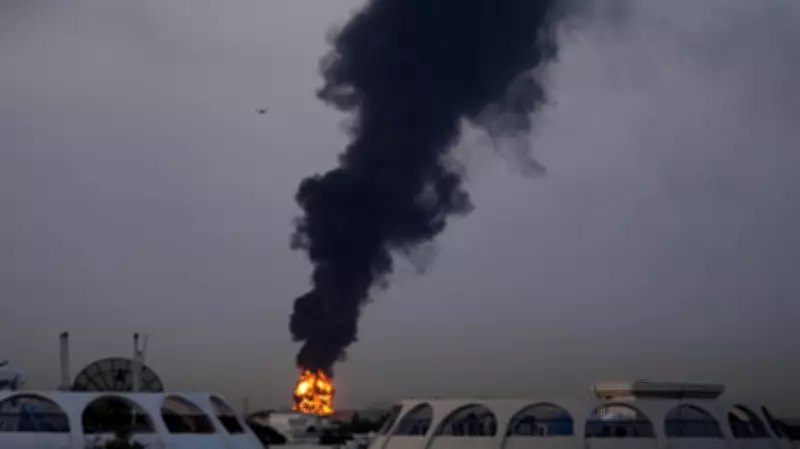
As morning broke on Monday, a drone struck a fuel tank near Dubai International Airport, the world's busiest hub for international passenger traffic, igniting a large fire. Firefighters successfully contained the blaze, and no injuries were reported, but the airport suspended all flights before resuming operations several hours later.
In a separate incident, a person was killed in the capital of the United Arab Emirates when an Iranian missile hit a vehicle, according to the Abu Dhabi media office. Additionally, a fire broke out at an oil facility in Fujairah, one of the UAE's seven emirates, following another drone attack. Meanwhile, Saudi Arabia announced it had intercepted a wave of 35 Iranian drones targeting its eastern region, which hosts major oil installations.
Since the conflict began, Iran has launched hundreds of missiles and drones toward countries in the region that host U.S. military assets. Emirati authorities report that most of these projectiles have been intercepted by air defenses, though debris and some drones have fallen within the country. Israel's military also confirmed early Monday that Iran launched missiles toward Israeli territory.
Economic Fallout and Global Response
The conflict is severely battering the global economy, driving up energy and fertilizer prices, threatening food shortages in impoverished nations, destabilizing fragile states, and complicating efforts by central banks to reduce consumer prices. A significant portion of these difficulties stems from the virtual shutdown of the Strait of Hormuz.
U.S. President Donald Trump stated he has demanded that approximately seven countries deploy warships to help keep the Strait of Hormuz open, but his appeals have thus far yielded no commitments. Trump emphasized his determination, warning that he would remember which allies decline to assist. He has previously appealed to nations including China, France, Japan, South Korea, and Britain for support.
Ahead of a meeting in Brussels, the European Union's foreign policy chief, Kaja Kallas, indicated that the bloc's foreign ministers would discuss possibly extending a naval mission that protects ships in the Red Sea to the Strait of Hormuz, though no specific details were provided. European leaders have expressed criticism toward the U.S. and Israel for lacking clarity regarding their objectives in the war.
German Foreign Minister Johann Wadephul questioned EU involvement on Sunday, asserting that security for the strait can only be achieved through a negotiated solution. Japanese Prime Minister Sanae Takaichi informed parliament on Monday that her government has not received any formal communication from Washington regarding Trump's call for assistance in protecting the strait. Japan, which imports over 90% of its crude oil from the Middle East, began releasing its oil reserves on Monday to address supply shortages and rising prices.
Military Escalation and Humanitarian Toll
Massive explosions were reported in Beirut as Israel launched new attacks on the Lebanese capital before dawn, targeting infrastructure associated with the Iran-linked Hezbollah militia group. The Israeli army has issued evacuation orders for numerous neighborhoods in Beirut and southern Lebanon, displacing more than 800,000 people to date.
In southern Lebanon, one person was killed in an Israeli airstrike early Monday, followed by the deaths of two paramedics who arrived at the scene, according to Lebanon's state-run National News Agency. At least 850 people have been killed by Israeli strikes so far.
Shortly after Israel's military announced new strikes on Tehran targeting infrastructure, explosions were heard in the Iranian capital and surrounding areas. More than 1,300 people have been killed in Iran, as reported by the Iranian Red Crescent.
Israel has conducted approximately 7,600 strikes on Iran, disabling 85% of its air defenses and destroying 70% of its missile launchers, according to military spokesman Lt. Col. Nadav Shoshani. He stated that Israel still has thousands of targets to hit and will continue attacks for as long as necessary. In Israel, 12 people have been killed by Iranian missile fire, and at least 13 U.S. military members have lost their lives in the conflict.