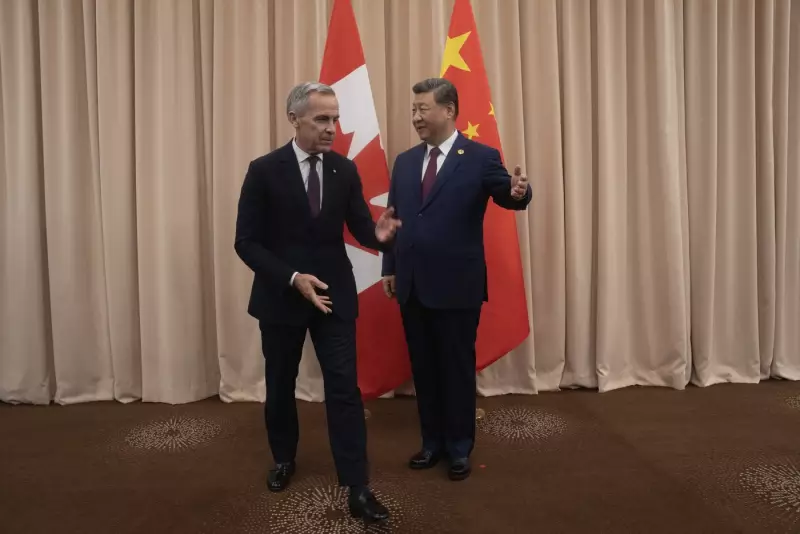
Prime Minister Mark Carney's forthcoming diplomatic mission to China is poised to become a critical test of his government's stated policy of 'pragmatic diplomacy.' The high-stakes visit, scheduled for early 2026, aims to navigate the complex terrain of revitalizing trade relations while managing significant geopolitical and security concerns, particularly the delicate balance with the United States under a potential second Trump administration.
A Delicate Balancing Act for Canadian Diplomacy
Carney's trip is set against a backdrop of what international security experts describe as "a history of economic coercion" by Beijing. The primary challenge for Ottawa will be to engage with one of its largest trading partners without appearing to undermine its strategic alliances or principles. Officials familiar with the preparations have indicated that while Canada is unlikely to secure the immediate removal of longstanding Chinese tariffs on key Canadian exports like canola and pork, the delegation hopes to make measurable progress on trade irritants.
This diplomatic tightrope is further complicated by concurrent political movements. Notably, several Liberal MPs have withdrawn from a separate parliamentary delegation to Taiwan, a move interpreted as an effort to "avoid confusion" and not provoke Beijing ahead of Carney's crucial visit. The sensitivity underscores the fine line the Prime Minister must walk between asserting Canadian interests and avoiding actions that could be perceived as endorsing China's strategic rivals.

Security Warnings and the U.S. Factor
Security analysts are urging a cautious approach. The core advice from experts is that Canada must enter negotiations with clear-eyed recognition of Beijing's tactics, which have historically included using trade as a tool for political leverage. The success of Carney's 'pragmatic diplomacy' will be measured not just by trade memorandums signed, but by whether the agreements safeguard Canadian economic and national security interests from potential coercion.
An overarching question shadowing the trip is how a renewed trade push with China will be received in Washington. With the headline 'Can Canada form a trade relationship with China without offending Trump?' capturing the central dilemma, the Canadian delegation must consider the impact on the vital Canada-U.S. relationship. Any perception of Ottawa moving closer to Beijing could trigger a negative response from a U.S. administration deeply skeptical of China's global ambitions.
Provincial Participation and Broader Context
Adding a domestic layer to the international mission, Saskatchewan Premier Scott Moe will join Carney on the trade mission. His participation signals provincial optimism about market access for key exports like potash and agricultural products, highlighting the economic stakes for regions across Canada. The trip occurs amidst other significant Canada-China developments, including the winding down of the Canadian operations of the Chinese-language newspaper Ming Pao, resulting in 60 staff layoffs.
As January 2026 approaches, all eyes will be on whether Prime Minister Carney's team can translate pragmatic rhetoric into tangible outcomes that benefit the Canadian economy while steadfastly protecting the nation's security and sovereign interests in an increasingly polarized world.