Conservative Leader Pierre Poilievre is set to announce a comprehensive plan for a renewed Auto Pact between Canada and the United States this Sunday in Windsor. He described the proposal as a "realistic" strategy designed to eliminate tariffs on Canadian auto sales in the American market, which he believes will strengthen both nations' automotive sectors.
Previewing the Proposal in Windsor
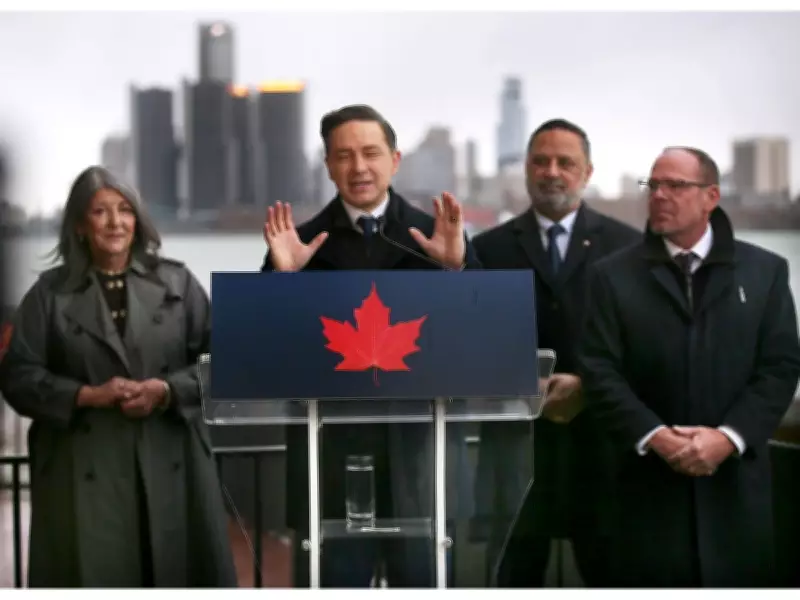
Before crossing the border to Detroit for meetings with auto industry executives on Friday morning, Poilievre outlined key elements of his proposal at a news conference held at the Windsor Club. With the Detroit skyline visible behind him, he emphasized that the plan would align Canadian regulations with those in the U.S. and remove the Goods and Services Tax (GST) from Canadian-made automobiles. "We will be making the case that both Detroit and Windsor are stronger when we trade together," Poilievre told reporters, highlighting the mutual benefits he envisions.
Cross-Border Meetings with Auto Executives
Following the press conference, Poilievre, accompanied by local Conservative MPs Kathy Borrelli (Windsor-Tecumseh-Lakeshore), Harb Gill (Windsor West), and Chris Lewis (Essex), traveled to Detroit, often referred to as the Motor City. There, they engaged in discussions with executives from major automotive companies, including Ford and General Motors. Poilievre noted that a meeting with Stellantis executives was also planned but had to be canceled due to scheduling conflicts.
In addition to these corporate meetings, Poilievre and the Windsor-Essex MPs are scheduled to meet with state senators from Michigan and Ohio. These discussions will focus on the automotive sector and efforts to advocate for tariff-free auto trade between the two countries, underscoring the cross-border collaboration essential to the proposal's success.
Economic Context and Strategic Goals
Poilievre linked the need for the renewed Auto Pact to recent economic challenges, citing a Statistics Canada report that indicated Canada lost 84,000 jobs in February. He described this as a "devastating" outcome, partly attributing it to what he called "Liberal failures" and policies that have weakened the economy. He argued that the American market is irreplaceable for Canadian auto exports, especially in light of Prime Minister Mark Carney's recent strategic partnership with China on electric vehicles, which Poilievre views as insufficient.
The proposed Auto Pact aims to "allow both the United States and Canada to grow their domestic production and repatriate our industry to our country, so that our people have paycheques and our national industrial base is stronger than ever," Poilievre explained. He stressed that regaining access to the U.S. market is critical for Canada's economic recovery and industrial strength.
Building Leverage Through Resources
A key component of Poilievre's strategy involves creating "leverage" by establishing a "strategic" energy and mineral reserve. He proposed making these resources available to allies with whom Canada has favorable trade terms, thereby strengthening the country's position in negotiations. This approach is intended to support the Auto Pact by ensuring Canada has the bargaining power needed to secure beneficial agreements.
Poilievre's visit to Detroit and the upcoming announcement in Windsor mark a significant step in his push for a renewed Auto Pact. As he prepares to fully unveil the plan on Sunday, the focus remains on fostering cross-border cooperation, eliminating trade barriers, and revitalizing the automotive industry in both Canada and the United States.