Trump Escalates Trade Feud with Canada Over China Agreement
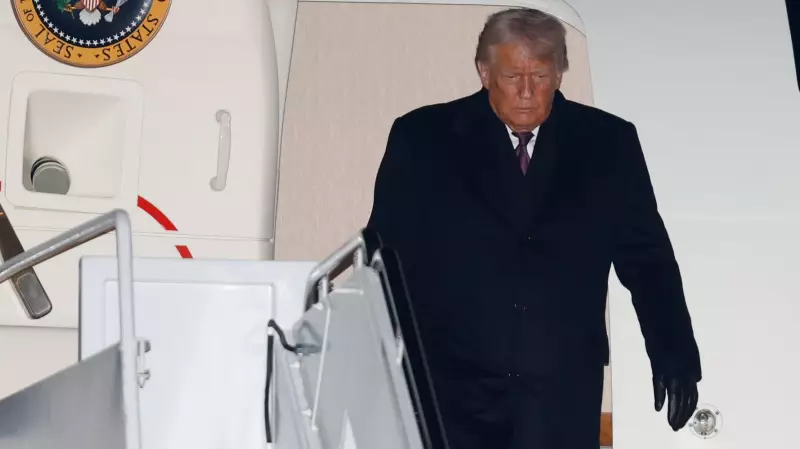
Former President Donald Trump issued a stark warning to Canada on Saturday, threatening to impose a 100% tariff on all goods imported from the northern neighbor if Prime Minister Mark Carney proceeds with a recently negotiated trade deal with China. This aggressive move intensifies an ongoing diplomatic and economic conflict between the two nations, highlighting growing tensions within North American trade relations.
A Direct Threat on Social Media
In a post on his Truth Social platform, Trump declared that if Carney believes Canada can become a "Drop Off Port" for Chinese goods destined for the United States, he is "sorely mistaken." This threat comes despite Trump initially praising the Canada-China agreement, which lowers tariffs on Chinese electric vehicles in exchange for reduced import taxes on Canadian agricultural products. The former president had previously called this deal something Carney "should be doing" and a "good thing" for Canada to sign.
Escalating Rhetoric and Diplomatic Tensions
The tariff threat emerges amid an escalating war of words between Trump and Carney, further strained by Trump's controversial push to acquire Greenland, which has tested NATO alliance cohesion. During the World Economic Forum in Davos, Switzerland, Trump remarked that "Canada lives because of the United States," prompting a sharp rebuttal from Carney. The Prime Minister asserted that "Canada doesn't live because of the United States. Canada thrives because we are Canadian," positioning his nation as a counterexample to autocratic tendencies.

Trump later revoked Carney's invitation to join a proposed "Board of Peace" aimed at resolving global conflicts, signaling a further deterioration in their relationship. The former president has repeatedly questioned Canadian sovereignty, even suggesting Canada be absorbed as a 51st state, and shared an altered map on social media depicting Canada, Venezuela, Greenland, and Cuba as part of U.S. territory.
Carney's Rising Profile and Middle Power Alliance
Prime Minister Carney has emerged as a leading voice advocating for middle-power nations to collaborate in countering U.S. influence under Trump. Speaking at Davos, Carney warned that "if you are not at the table, you are on the menu," emphasizing the need for collective action against coercion by great powers. His remarks received widespread international praise, upstaging Trump at the forum and highlighting a growing "rupture" between the U.S. and its Western allies that Carney believes may be irreparable.
In his Saturday post, Trump escalated his rhetoric further, claiming that "China will eat Canada alive, completely devour it, including the destruction of their businesses, social fabric, and general way of life." Despite these tensions, Canada remains protected from the worst impacts of Trump's tariffs by the Canada-U.S.-Mexico Agreement (CUSMA), which is up for review this year.
Background on Trade Relations and Economic Ties
Canada initially mirrored U.S. trade policies by imposing a 100% tariff on Chinese electric vehicles and 25% tariffs on steel and aluminum. China retaliated with 100% import taxes on Canadian canola oil and meal, and 25% on pork and seafood. However, as Trump pursued pressure tactics, Canada's foreign policy has diverged, creating an opening for improved relations with Beijing.
The economic interdependence between Canada and the U.S. remains profound:
- Canada is the top export destination for 36 U.S. states.
- Nearly $3.6 billion CAD ($2.7 billion USD) in goods and services cross the border daily.
- Approximately 60% of U.S. crude oil imports and 85% of U.S. electricity imports come from Canada.
- Canada is the largest foreign supplier of steel, aluminum, and uranium to the U.S., with 34 critical minerals and metals vital for national security.
Professor Emeritus Nelson Wiseman of the University of Toronto notes that while the China trade deal is currently limited, similar to U.S. agreements on semiconductors, it may expand, potentially including Chinese investment in a pipeline to northern British Columbia.

Prime Minister Carney has acknowledged the complexity of Canada's relationship with the U.S., emphasizing deeper ties while maintaining disagreements on issues like human rights with China. This delicate balancing act continues to define Canada's trade and diplomatic strategy amid escalating tensions with its southern neighbor.