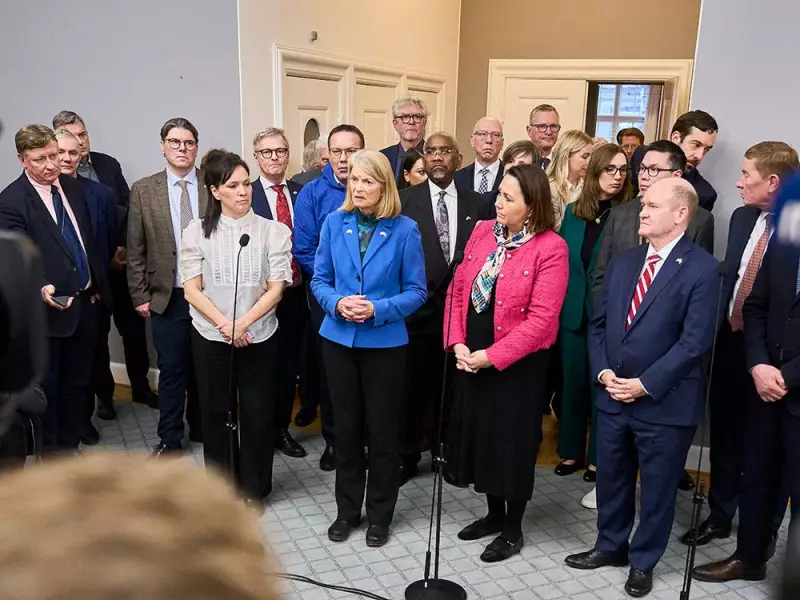
In a significant escalation of a long-running diplomatic dispute, former U.S. President Donald Trump has threatened to impose fresh tariffs on countries that oppose his push for the United States to take control of Greenland. The threat came as a bipartisan delegation of U.S. senators and representatives met with lawmakers in the Danish parliament in Copenhagen on Friday, January 16, 2026, to discuss the contentious issue.
Tariffs as a Tool for Foreign Policy
Speaking at a White House event focused on healthcare, Trump explicitly linked his tariff agenda to his Greenland ambitions. "I may put a tariff on countries if they don’t go along with Greenland, because we need Greenland for national security," he stated, though he did not provide specific details on which nations or goods might be targeted.
This move aligns with Trump's historical use of sweeping tariff threats to pressure other nations into aligning with his foreign policy and economic priorities. Just this week, he threatened 25% tariffs on goods from countries trading with Iran, a threat he has yet to act upon. The Greenland issue now appears to be folded into this strategy, with the president framing control of the vast Arctic island as a critical security imperative.

"NATO has been dealing with us on Greenland," Trump told reporters later on Friday. "We need Greenland for national security very badly. If we don’t have it, we have a big hole in national security."
Congressional Pushback in Copenhagen
Simultaneously, a delegation of U.S. lawmakers, led by Democratic Senator Chris Coons of Delaware, engaged in what were described as "good and robust" talks with Danish parliamentarians. The meetings in Copenhagen followed a week of discussions in Washington involving Danish Foreign Minister Lars Lokke Rasmussen, Vice President JD Vance, Secretary of State Marco Rubio, and Greenland's own Foreign Minister, Vivian Motzfeldt.
The congressional trip underscores efforts by Denmark and Greenland to build support on Capitol Hill, where lawmakers' control over federal spending could potentially constrain any future White House actions against the autonomous Danish territory. The delegation included prominent critics of Trump's Greenland plan, such as Alaska Republican Senator Lisa Murkowski, a veteran of Arctic affairs.
"Greenland needs to be viewed as our ally, not as an asset," Murkowski emphasized to reporters in the Danish capital. "And I think that’s what you’re hearing with this delegation." She pointed out that a majority of Americans are opposed to acquiring the polar territory.
A Stalemate with Global Implications
The situation remains at a diplomatic impasse. While officials agreed this week to establish a working group to manage the dispute, fundamental disagreements persist. Trump has repeatedly and insistently stated that the U.S. must control Greenland, a position consistently and firmly rejected by both the Danish government and the Greenlandic people.
Senator Coons summarized the U.S. congressional position after the Copenhagen meetings, stating, "We spoke with clarity about the importance that the people of Greenland make their decisions about their future. It was a constructive and hopeful dialogue, and we look forward to continuing."
The political friction is also sparking public dissent, with protests against Trump's Greenland plans scheduled across Denmark on Saturday. The event highlights how a U.S. president's unconventional geopolitical ambition continues to strain alliances and provoke international concern, with the resource-rich and strategically located Arctic at the centre of the storm.