Canadian Housing Activity Stays Subdued in February 2026
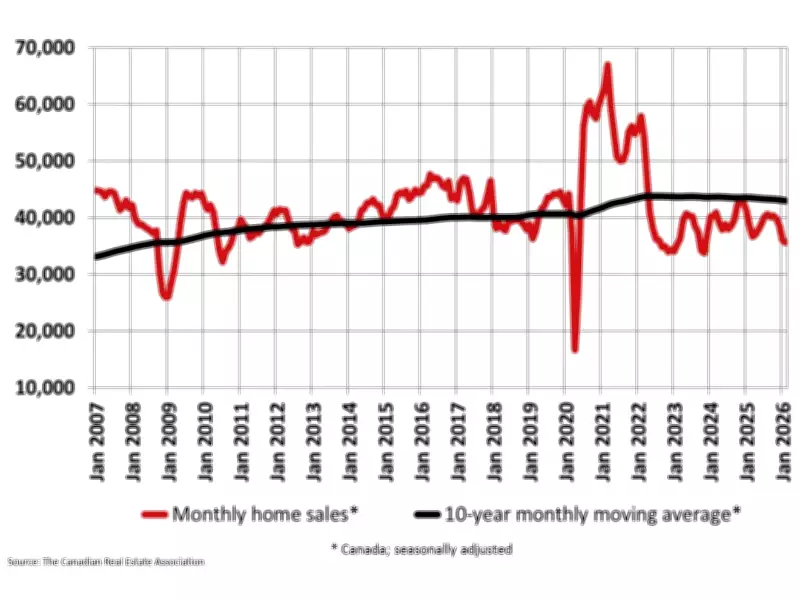
The Canadian real estate market continued its period of relative calm in February 2026, with key indicators showing modest declines and a cautious atmosphere prevailing among buyers and sellers. According to data from the Canadian Real Estate Association (CREA), national home sales recorded over MLS® Systems dipped by 1.3% on a month-over-month basis. This follows a similarly quiet January, suggesting a slow start to the year for the housing sector.
Key Metrics Reflect a Cooling Market
The monthly figures reveal a broader trend of reduced activity. On a year-over-year basis, actual (not seasonally adjusted) monthly sales were down 8.1% compared to February 2025. The number of newly listed properties also declined, falling by 3.9% month-over-month, which erased the increase seen in January. This reduction in new supply outpaced the drop in sales, leading to a slight tightening in the sales-to-new listings ratio, which moved to 47.6% from 46.4% in January.
Shaun Cathcart, CREA’s Senior Economist, commented on the situation, stating, "February saw a continuation of the quieter levels of activity recorded in January, although there was some indication things were starting to pick up speed toward the end of the month." He added that 2026 is still anticipated to be driven by pent-up demand from first-time buyers, but many are waiting for more favorable conditions, particularly in markets like Ontario and British Columbia.
Price Movements and Inventory Levels
The MLS® Home Price Index (HPI) showed a decline of 0.6% month-over-month in February, which, while not insignificant, was smaller than the drop observed in January. On a year-over-year basis, the non-seasonally adjusted National Composite MLS® HPI was down 4.8%. Regionally, price decreases in British Columbia, Alberta, and Ontario offset gains in other provinces, highlighting varied market conditions across the country.
The actual national average sale price was nearly unchanged, dipping by just 0.2% year-over-year to $663,828 in February 2026. At the end of the month, there were 151,850 properties listed for sale on Canadian MLS® Systems, representing a 3.7% increase from a year earlier but remaining 12.3% below the long-term average for that time of year.
Market Balance and Regional Variations
Inventory levels indicated a balanced market on a national scale, with five months of inventory at the end of February 2026, unchanged from January and aligning with the long-term average. However, this national figure masks significant regional disparities. Valérie Paquin, CREA Chair, noted, "Housing market activity in February remained slow, particularly in the stretch of Ontario between Windsor and Toronto." She emphasized that the spring market typically gains momentum around April, suggesting there is still time for buyers and sellers to engage this year.
The sales-to-new listings ratio's long-term average is 54.8%, with readings between 45% and 65% generally indicating balanced conditions. The current ratio of 47.6% suggests a market that is leaning slightly toward buyers but remains within a stable range. Based on standard deviations, a seller's market would be below 3.6 months of inventory, while a buyer's market would exceed 6.4 months, underscoring the nuanced state of the Canadian housing landscape.